


By Indexopedia Research Team | September 5, 2024 | In
The U.S. Federal Reserve, commonly referred to as the Fed, plays a pivotal role in the American economy. As the central bank of the United States, its primary function is to manage the country’s monetary policy. This involves a complex process of setting interest rates, regulating the money supply, and ensuring the stability of the financial system. For affluent investors, understanding how the Fed sets policy is crucial, as its decisions can have far-reaching effects on investment portfolios, particularly those with significant exposure to interest rate-sensitive assets, as we will discuss in more detail later.
The Structure of the Federal Reserve
To fully grasp how the Fed sets policy, it’s important to first understand its structure. The Federal Reserve System is made up of three key entities:
- The Board of Governors: Located in Washington, D.C., the Board of Governors consists of seven members appointed by the President and confirmed by the Senate. These governors serve staggered 14-year terms to ensure stability and continuity in monetary policy.
- The Twelve Regional Federal Reserve Banks: Each of these banks serves a specific region of the U.S. and operates semi-independently, conducting research and providing services to financial institutions. They also contribute to the Fed’s policy decisions through the FOMC.
- The Federal Open Market Committee (FOMC): The FOMC is the policy-making body of the Fed. It includes the seven members of the Board of Governors and five of the twelve Reserve Bank presidents. The President of the Federal Reserve Bank of New York is a permanent member, while the other four seats rotate among the remaining eleven Reserve Bank presidents.
The Fed’s Dual Mandate
At the heart of the Fed’s policy-making process is its dual mandate, which requires the central bank to achieve two primary goals: maximum employment and stable prices. This mandate guides all of the Fed’s actions and serves as the foundation for its policy decisions.
- Maximum Employment: The Fed aims to ensure that as many people as possible are gainfully employed. However, this doesn’t mean achieving zero unemployment, as there is always a natural level of unemployment due to factors like job transitions and the time it takes to match workers with jobs.
- Stable Prices: The Fed seeks to keep inflation low and stable. The target inflation rate is typically around 2%, which is considered conducive to economic stability and growth. By keeping inflation in check, the Fed helps maintain the purchasing power of the dollar, which is crucial for investors.
Tools of Monetary Policy
The Fed has several tools at its disposal to achieve its dual mandate. The most important of these are:
- The Federal Funds Rate: The Fed’s primary tool for influencing the economy is the federal funds rate, which is the interest rate at which banks lend to each other overnight. By raising or lowering this rate, the Fed can influence borrowing costs, consumer spending, and investment.
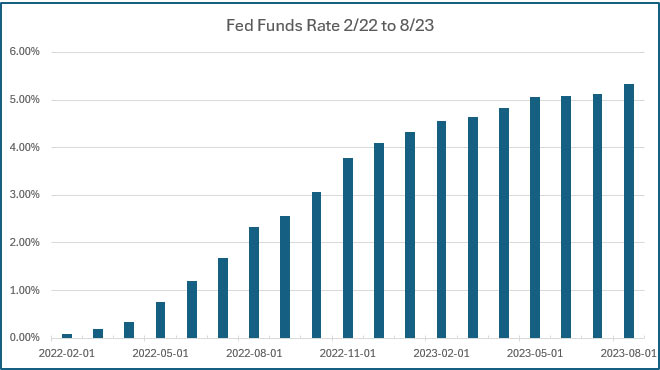
- Example: In response to creeping inflation in 2022, the Fed hiked the federal funds rate from near zero to 5.33% in an effort to cool down the economy. In fact, the Fed raised rates 11 times from March, 2022 to August of 2023. It marked one of the most aggressive tightening cycles in recent history (see Exhibit 1).
- Open Market Operations (OMOs): Through OMOs, the Fed buys or sells government securities in the open market to influence the money supply. When the Fed buys securities, it injects money into the economy, lowering interest rates and encouraging spending. When it sells securities, it pulls money out of the economy, raising interest rates and curbing inflation.
- Example: In the years following the 2008 crisis, the Fed engaged in a series of OMOs known as quantitative easing (QE). By purchasing large amounts of government and mortgage-backed securities, the Fed increased the money supply and lowered long-term interest rates, supporting the economic recovery.
- The Discount Rate: This is the interest rate the Fed charges banks for borrowing directly from the Federal Reserve. While it’s used less frequently than the federal funds rate, changes in the discount rate can signal the Fed’s policy intentions and influence overall credit conditions in the economy.
- Example: During the COVID-19 pandemic in 2020, the Fed quickly lowered the discount rate to near zero to ensure that banks had access to cheap funding, thereby preventing a liquidity crisis and stabilizing the financial system.
- Reserve Requirements: The Fed can also influence the economy by changing the reserve requirements for banks, which is the amount of money banks are required to hold in reserve against deposits. Lowering reserve requirements increases the money supply by freeing up more funds for lending, while raising them does the opposite.
- Example: Although the Fed has rarely adjusted reserve requirements in recent decades, it took an unprecedented step in March 2020 by reducing the reserve requirement ratio to zero in response to the economic turmoil caused by the pandemic. This move freed up billions of dollars for banks to lend, helping to keep credit flowing during a critical time.
The Process of Setting Policy
The Fed’s policy-making process is a well-structured and deliberate one, centered around the FOMC’s regular meetings. The FOMC meets eight times a year to review economic conditions and make decisions about monetary policy. Here’s a detailed look at the process:
- Economic Data Analysis: Before each FOMC meeting, the Fed’s staff and economists at the regional Reserve Banks gather and analyze a wide range of economic data. This includes information on employment, inflation, consumer spending, business investment, and global economic conditions.
- Example: In the lead-up to the March 2020 FOMC meeting, the Fed’s staff closely monitored the rapidly deteriorating economic data as the COVID-19 pandemic began to spread. This data included sharp declines in consumer spending, rising unemployment claims, and disruptions to global supply chains, all of which informed the Fed’s aggressive policy response.
- Discussion and Deliberation: During the FOMC meetings, members discuss the economic outlook and debate the appropriate course of action. This discussion is guided by the Fed’s dual mandate, with members considering the likely impact of different policy options on employment and inflation.
- Example: In the December 2018 FOMC meeting, members debated whether to continue raising interest rates amid signs of slowing global growth and market volatility. Ultimately, the committee decided to raise rates but signaled a more cautious approach going forward, reflecting concerns about the economic outlook.
- Policy Decision and Communication: After deliberation, the FOMC votes on the policy action, which is then announced to the public. The Fed uses statements, press conferences, and economic projections to communicate its decisions and the rationale behind them.
- Example: In September 2020, the Fed announced a shift to a new monetary policy framework that would allow inflation to run above 2% for some time, a significant change from its previous approach. This shift was communicated through a detailed statement and press conference, emphasizing the Fed’s commitment to supporting the economic recovery.
- Implementation and Monitoring: Once a policy decision is made, the Fed implements it through its operational tools, such as OMOs and adjustments to the federal funds rate. The Fed then closely monitors the economy to assess the impact of its actions and determine whether further adjustments are needed.
- Example: After implementing QE during the 2008 crisis, the Fed closely monitored the economy’s response, including changes in interest rates, inflation, and employment. As the economy recovered, the Fed gradually tapered its asset purchases and eventually began raising interest rates, carefully calibrating its actions to avoid disrupting the recovery.
The Impact of Fed Policy on Investors
For affluent investors, the Fed’s policy decisions can have profound implications. Changes in interest rates, for example, directly affect the returns on fixed-income investments like bonds, as well as the cost of borrowing for leveraged investments. Similarly, the Fed’s actions can influence the stock market, particularly sectors that are sensitive to interest rates, such as real estate and utilities.
- Example: When the Fed aggressively raised rates in 2022, growth stocks were hit particularly hard. Higher interest rates meant higher cost of capital and a large reduction in future earnings potential, which is the lifeblood of a growth stock. In the exhibit below (Exhibit 2), it is clear that growth stocks suffered as the Fed raised rates:
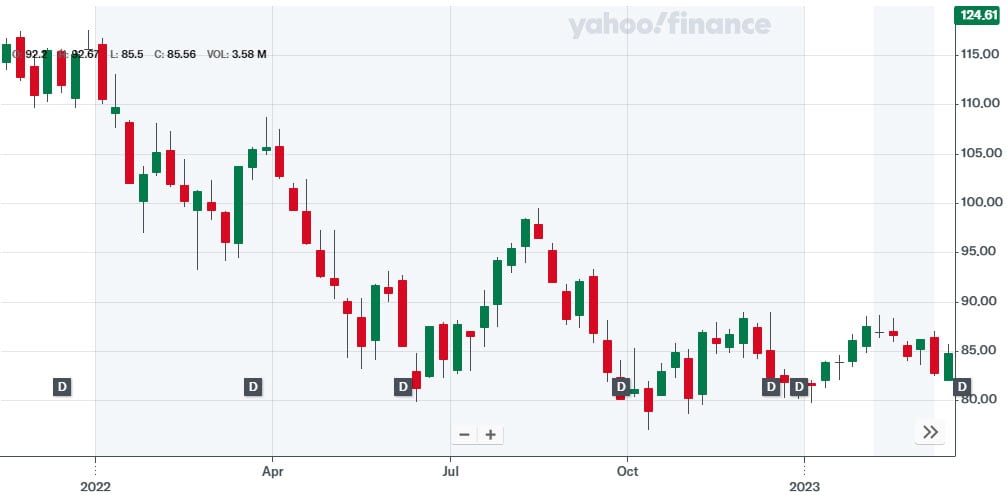
Source: Yahoo Finance (IUSG: iShares Core S&P U.S. Growth ETF)
Conclusion
Understanding how the Federal Reserve sets policy is essential for any investor, especially those with significant assets at stake. The Fed’s decisions on interest rates, money supply, and other policy tools can have a direct impact on investment portfolios, influencing everything from bond yields to stock prices. By staying informed about the Fed’s policy-making process and the factors that drive its decisions, affluent investors can better navigate the complex landscape of the financial markets and make more informed investment choices.
Related Articles
Federal Funds Rate/Risk-Free Rate
Economics,
Interests Rates,
November 3, 2023
What are the markers of inflation, recession, and a healthy economy?
Economic Indicators,
Economics,
Top Economics FAQs,
September 5, 2024

What is Inflation?
Economic Indicators,
Economics,
Top Economics FAQs,
November 3, 2023