

Steady Growth in a Supportive Market Environment
For investors, 2005 was a year characterized by steady economic growth, supportive financial conditions, and generally constructive market performance. While returns were not dramatic, markets benefited from a favorable combination of accommodative monetary policy, solid corporate earnings, and continued confidence in the economic expansion that followed the early-2000s recession.
Unlike the volatility that would define later years, 2005 rewarded patience and diversification, reinforcing the sense that markets were operating within a stable and predictable framework.
Economic Expansion Continues
The U.S. economy continued to grow at a moderate pace in 2005, with real GDP expanding by roughly 3%. Consumer spending remained resilient, supported by employment gains, rising home values, and accessible credit. Business investment improved as corporate balance sheets strengthened and profit margins remained elevated.
Globally, economic growth was broad-based. Emerging markets expanded rapidly, while Europe and Japan showed signs of improving momentum after periods of sluggish performance. China’s economy grew at an estimated pace near 10%, reinforcing its role as a key driver of global demand for commodities and industrial goods.
Inflation pressures were present but manageable. Energy prices rose sharply during the year, with oil prices climbing from roughly $43 per barrel at the start of 2005 to over $60 by year-end, driven by strong global demand and supply disruptions.
Federal Reserve Tightens Policy Gradually
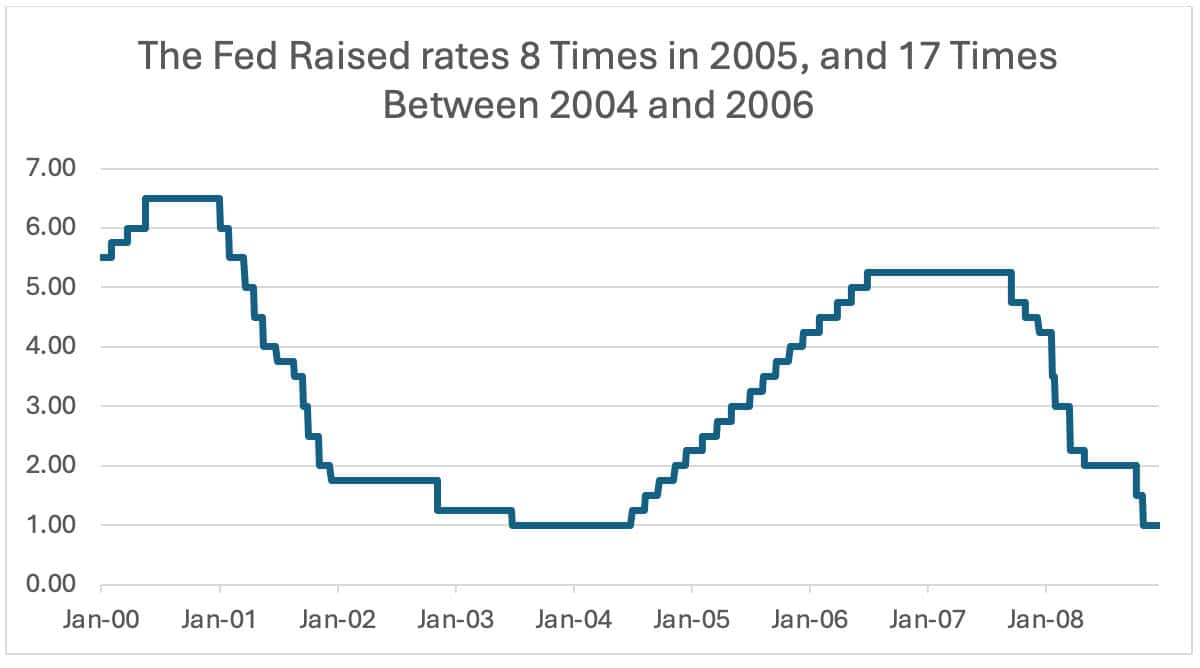
Monetary policy was a central theme in 2005. The Federal Reserve continued its gradual tightening cycle, raising the federal funds rate eight times during the year, from 2.25% to 4.25%. These moves reflected confidence in the economic recovery and an effort to normalize policy after several years of exceptionally low rates.
Importantly for markets, the pace of tightening was well telegraphed. Investors viewed the Fed’s actions as predictable and orderly, which helped limit volatility. Long-term interest rates remained relatively stable, with the 10-year Treasury yield ending the year near 4.4%, contributing to favorable financial conditions even as short-term rates moved higher.
Housing Market Remains a Key Driver
The housing market played an increasingly important role in the economy and markets during 2005. National home prices continued to rise at a mid-to-high single-digit pace, fueling household wealth and supporting consumer spending. Mortgage credit remained widely available, and refinancing activity helped households manage debt levels.
At the same time, some early signs of excess began to emerge. Speculative activity increased in certain regions, lending standards loosened, and household leverage rose. Adjustable-rate and interest-only mortgages became more common, particularly in overheated markets such as California, Florida, and parts of the Southwest.
For most investors in 2005, however, housing strength was seen as a stabilizing force rather than a source of risk.
Equity Markets Post Moderate Gains
Equity markets delivered modest but positive returns in 2005. The S&P 500 gained approximately 5%, while the Dow Jones Industrial Average rose closer to 1%, reflecting steady earnings growth but also periods of consolidation as valuations adjusted to rising interest rates.
Leadership rotated throughout the year. Energy stocks benefited from elevated oil prices and strong cash flows, while financial stocks performed well amid robust mortgage activity and healthy credit conditions. Technology shares stabilized after several years of uneven performance, though enthusiasm remained measured.
International equities also posted gains, supported by global growth and favorable currency trends. Emerging markets, in particular, continued to attract investor interest as diversification opportunities expanded beyond U.S. borders.
Bonds and Credit Remain Supportive
Fixed income markets provided stability in 2005, though rising short-term rates limited total returns. Treasury yields increased modestly, reflecting the Federal Reserve’s tightening cycle, while long-term rates remained relatively anchored.
Credit markets remained constructive. Corporate bond spreads stayed narrow, reflecting low default rates and strong investor demand for yield. Both investment-grade and high-yield bonds benefited from improving corporate fundamentals and ample liquidity.
Confidence Builds Late in the Cycle
By year-end, investor sentiment remained positive. Economic growth appeared sustainable, earnings were solid, and financial conditions were supportive. Volatility stayed relatively low, even in the wake of major disruptions such as Hurricanes Katrina and Rita, which temporarily affected energy markets and economic activity.
For long-term investors, 2005 illustrated how steady returns can be generated during periods of economic expansion and policy normalization. At the same time, the year quietly laid the groundwork for future challenges, reminding investors that stability and risk can coexist—even when markets appear calm.