


A Year Defined by Volatility, Policy Risk, and Shaken Confidence
For investors, 2011 was a difficult and emotionally taxing year. Markets were dominated less by traditional economic fundamentals and more by political decisions, sovereign debt concerns, and rapidly shifting confidence. Although the global economy continued to expand modestly, investors faced repeated reminders that the post-crisis environment remained fragile and highly sensitive to policy missteps.
The year unfolded as a test of patience, discipline, and diversification, reinforcing how quickly market sentiment can change even during an economic recovery.
Europe’s Sovereign Debt Crisis Escalates
The dominant market story of 2011 was the escalation of Europe’s sovereign debt crisis. Concerns surrounding Greece intensified as it became increasingly clear that earlier bailout efforts were insufficient to stabilize the country’s finances. Investors questioned whether Greece could meet its obligations or remain within the eurozone, raising fears of broader contagion.
These concerns quickly spread to other heavily indebted countries, including Italy, Spain, Portugal, and Ireland. Bond yields in several of these nations rose sharply, signaling declining investor confidence and increasing borrowing costs. Each new summit, vote, or policy announcement triggered sharp swings in global markets, reflecting uncertainty over whether European leaders could contain the crisis.
Although European policymakers eventually introduced measures to support banks and sovereign debt markets, progress was slow and uneven. For investors, the crisis highlighted how regional problems could become global market events and reinforced the importance of monitoring political as well as economic risk when constructing portfolios.
U.S. Debt Ceiling Crisis Undermines Confidence
While Europe dominated headlines, the United States faced its own crisis of confidence in 2011. During the summer, political brinkmanship over raising the federal debt ceiling raised the unprecedented possibility of a U.S. government default. Markets reacted sharply as negotiations dragged on, and investor anxiety increased.
Although a last-minute agreement was reached, the damage to confidence was significant. Shortly thereafter, Standard & Poor’s downgraded U.S. government debt from AAA to AA+, citing concerns over fiscal governance and political dysfunction. Equity markets fell sharply in response, and volatility surged.
Ironically, U.S. Treasury bonds rallied during this period, as investors sought safety despite the downgrade. This counterintuitive reaction underscored the lack of perceived alternatives during periods of stress and reinforced Treasuries’ role as a global safe haven during periods of global uncertainty.
Equity Markets Struggle for Direction
Equity markets reflected the year’s instability. The S&P 500 finished 2011 with a modest gain of just over 2%, but that headline number masked significant volatility along the way. The Dow Jones Industrial Average declined approximately 5%, while the Nasdaq Composite posted a small gain.
Markets experienced multiple sharp sell-offs, including a dramatic decline during the summer amid debt ceiling fears and European turmoil. Investor sentiment swung rapidly between optimism and fear, making it difficult for markets to sustain momentum or establish lasting trends.
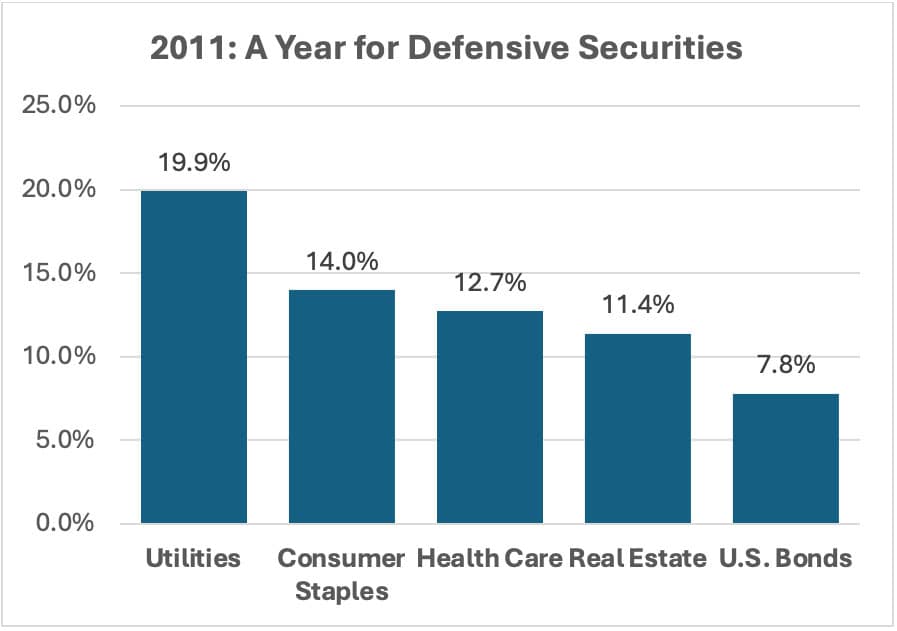
Defensive sectors such as consumer staples, utilities, and healthcare outperformed as investors sought stability and income. Dividend-paying stocks became increasingly attractive in a low-interest-rate environment, reinforcing the importance of income-oriented strategies during uncertain periods.
Bonds Play a Critical Stabilizing Role
Fixed income markets once again demonstrated their value in diversified portfolios. As equity volatility increased, investors flocked to high-quality bonds, driving yields lower. The 10-year Treasury yield fell from approximately 3.3% at the start of the year to below 2% by year-end.
The Bloomberg U.S. Aggregate Bond Index returned roughly 7.8% in 2011, providing strong diversification benefits. Bonds helped offset equity losses during periods of stress and reinforced their role as a stabilizing force amid market turbulence.
Economic Growth Continues, but Unevenly
Despite market volatility, economic conditions continued to improve modestly. U.S. employment grew gradually, corporate earnings remained resilient, and the economy avoided recession. However, growth remained uneven, and confidence was repeatedly shaken by external shocks and policy-driven uncertainty.
This disconnect between improving fundamentals and volatile markets proved challenging for investors, highlighting the difference between economic progress and market behavior.
Looking Back at 2011
By the end of 2011, investors had endured a year defined by uncertainty rather than growth. Political risk, sovereign debt concerns, and shifting confidence dominated market outcomes. For long-term investors, the year reinforced the importance of discipline, diversification, and staying focused on long-term objectives—even when short-term headlines, volatility spikes, and emotionally charged market moves threatened to derail carefully constructed investment plans.