


By Indexopedia Research Team | August 14, 2024 | In
Cryptocurrency has taken the financial world by storm in recent years, offering investors a new and exciting way to potentially earn substantial returns on their investments. However, along with the potential for great profits, investing in cryptocurrency also comes with its fair share of risks. Five of the most notable risks are as follows:
Market Volatility
One of the biggest risks of investing in cryptocurrency is the extreme volatility of the market. Cryptocurrencies are known for their dramatic price swings, with prices sometimes rising or falling by double-digit percentages in a matter of hours. This volatility can lead to significant losses for investors who are not prepared for it.
For example, in late 2021, Bitcoin saw its price soar to nearly $70,000, only to crash to around $16,000 a year later. Investors who bought at the peak of the market faced steep losses as the price plummeted. This extreme volatility can make it difficult to predict price movements and make informed investment decisions.
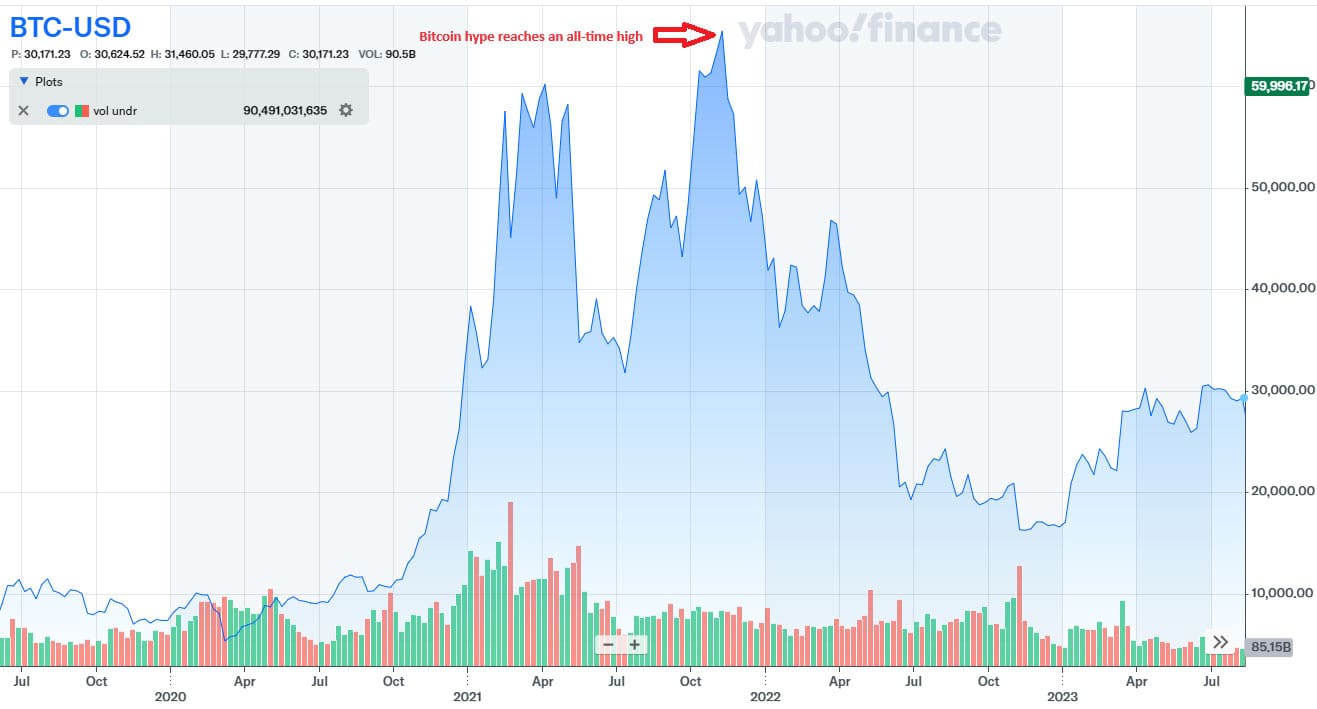
Exhibit 1 (Source: Yahoo! Finance)
Regulatory Risks
Another risk of investing in cryptocurrency is the lack of regulation in the market. Unlike traditional financial markets, the cryptocurrency market is largely unregulated, making it susceptible to fraud, manipulation, and other illegal activities. Scams and Ponzi schemes are not uncommon in the world of cryptocurrency, and unsuspecting investors can lose their entire investment as a result.
One high-profile example of this is the case of Bitconnect, a cryptocurrency project that promised investors guaranteed returns on their investment. However, it was later revealed to be a Ponzi scheme, with the founders disappearing with millions of dollars of investors’ money. This lack of regulation can make it difficult for investors to protect themselves from fraudulent activities and can lead to substantial losses.
A related risk is the one associated with regulatory crackdowns. As cryptocurrencies have gained popularity, governments around the world have started to pay closer attention to them and have implemented regulations to control their use. These regulations can range from restrictions on cryptocurrency trading to outright bans on their use.
For example, in 2017, China banned Initial Coin Offerings (ICOs), a popular method for raising funds through cryptocurrency, citing concerns about fraud and financial stability. This move caused a sharp drop in the price of Bitcoin and other cryptocurrencies, as investors feared further regulatory crackdowns. Investors in China were left with limited options for trading and investing in cryptocurrency, which negatively impacted their investment portfolios.
Inadequate regulation is also partly to blame for the high-profile collapse of FTX in 2022. FTX was one of the largest cryptocurrency exchanges in the world prior to its downfall. While internal mismanagement was clearly one of the factors leading to FTX’s collapse, the lack of regulatory oversight played an equally important role. Since FTX operated in a largely unregulated arena, the company was able to exploit loopholes in the scant regulatory framework. The silver lining in the FTX incident is that it prompted reforms in cryptocurrency regulation which should be to the benefit of future investors.
Security Risks
 Additionally, investing in cryptocurrency carries the risk of security breaches and hacking. The decentralized nature of cryptocurrencies means that they are stored in digital wallets, which can be vulnerable to hacking and theft. In recent years, several cryptocurrency exchanges and platforms have been hacked, resulting in millions of dollars worth of cryptocurrency being stolen.
For example, in 2018, the Japanese cryptocurrency exchange Coincheck was hacked, with hackers stealing over $500 million worth of cryptocurrency from the exchange. This incident highlighted the security risks associated with investing in cryptocurrency and the importance of taking appropriate measures to protect one’s investment.
Technology Risks
Additionally, investing in cryptocurrency carries the risk of technological obsolescence. The cryptocurrency market is constantly evolving, with new cryptocurrencies and blockchain technologies emerging every day. While some of these projects may be successful and gain widespread adoption, others may fail to gain traction and eventually become obsolete.
For instance, in the early days of cryptocurrency, there were many projects that promised innovative solutions but ultimately failed to deliver on their promises. Investors who had invested in these projects faced significant losses as the projects failed to gain support from the community and were abandoned.
Market Manipulation
Cryptocurrency markets are less regulated than traditional financial markets, making them more susceptible to manipulation. Whales (large holders of cryptocurrency) can influence prices through large trades, and coordinated efforts (pump and dump schemes) can artificially inflate or deflate prices.
In 2021, various small-cap cryptocurrencies saw massive price increases followed by sharp declines, suspected to be the result of pump and dump schemes. These schemes often involve coordinated buying to inflate the price, followed by a sudden sell-off, leaving late investors with significant losses.
Conclusion
In conclusion, investing in cryptocurrency can offer exciting opportunities for investors to earn substantial returns on their investments. However, it also comes with its fair share of risks, including extreme volatility, lack of regulation, security breaches, regulatory crackdowns, technological obsolescence, and the risk of market manipulation. To mitigate these risks, investors should conduct thorough research, diversify their investments, and only invest what they can afford to lose. By understanding the risks associated with investing in cryptocurrency and taking appropriate precautions, investors can make informed decisions and navigate this burgeoning market successfully.
Related Articles

Is AI Sabotaging Your Wealth? The Risks Every Investor Needs to Know
Personal Finance,
Top Personal Finance FAQs,
August 12, 2024
What is Cryptocurrency?
Index Investing,
Index Sectors,
Markets,
Top Markets FAQs,
January 12, 2024

What are the Different Types of Risks that Can Affect an Investor’s Portfolio?
Investment Principles,
Portfolio Considerations,
February 19, 2025