

A Year Dominated by Policy and Fragile Confidence
2012 was a year defined less by economic strength and more by policy intervention. While financial markets ultimately delivered solid returns, investor confidence remained fragile throughout much of the year. Memories of the financial crisis and the European debt turmoil were still fresh, and markets proved highly sensitive to political decisions, central bank actions, and headline risk.
For long-term investors, 2012 reinforced a familiar post-crisis lesson: market outcomes were increasingly shaped by policymakers rather than traditional economic cycles, and sentiment could shift quickly based on words as much as actions.
Europe Takes Center Stage
The most significant source of uncertainty in 2012 came from Europe. Concerns over sovereign debt levels, fragile banking systems, and the future of the euro dominated headlines for much of the year. Countries such as Greece, Spain, and Italy faced rising borrowing costs, while fears of a eurozone breakup periodically rattled global markets.
Investor confidence began to stabilize only after European Central Bank President Mario Draghi famously pledged to do “whatever it takes” to preserve the euro. This commitment, later formalized through the ECB’s Outright Monetary Transactions program, reassured markets that systemic collapse would be avoided.
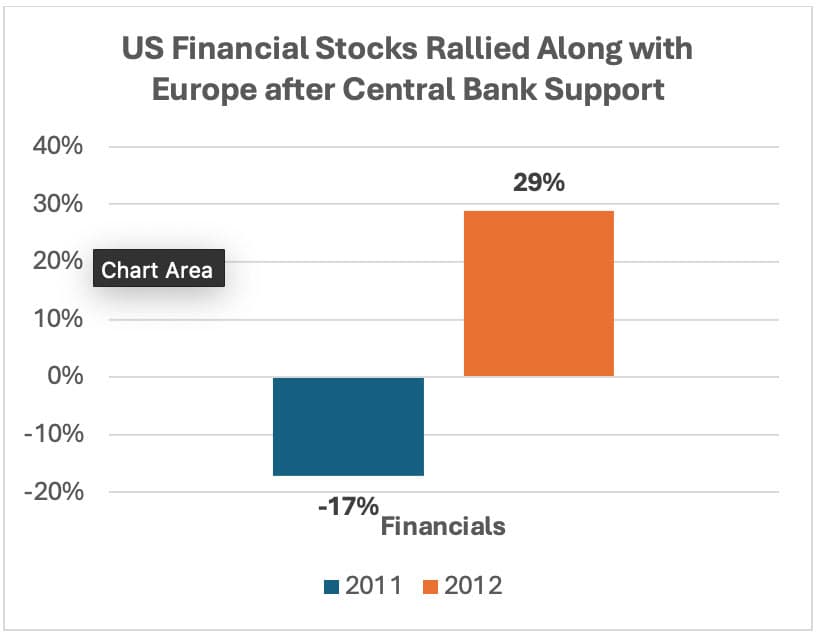
The impact was immediate. Bond yields in peripheral European countries declined sharply, equity markets rallied, and risk premiums narrowed. For investors, the episode underscored how critical central bank credibility had become in shaping market behavior and restoring confidence during periods of stress.
U.S. Economic Growth Remains Uneven but Resilient
In the United States, economic growth continued at a modest but steady pace. Employment gains were gradual, consumer spending improved incrementally, and the housing market showed early signs of recovery after several difficult years. While growth remained below historical averages, it was sufficient to reduce fears of a renewed recession.
Corporate earnings held up better than many expected, supported by cost discipline and improving margins. These fundamentals provided an anchor for markets even as political uncertainty increased later in the year.
Equity Markets Post Solid Gains
Despite persistent uncertainty, U.S. equity markets delivered solid returns in 2012. The S&P 500 gained 16%, reflecting improving sentiment as systemic risks receded. The Dow Jones Industrial Average rose around 7%, while the Nasdaq Composite advanced roughly 15%.
Returns were driven less by enthusiasm and more by relief. As worst-case scenarios failed to materialize, investors gradually re-engaged with risk assets. Dividend-paying stocks and defensive sectors such as consumer staples and healthcare attracted increased attention in a low-yield environment.
Market volatility remained elevated at times, particularly during periods of heightened European stress and political uncertainty in the U.S., but the overall trend remained positive.
The Federal Reserve Expands Its Role
Monetary policy remained a dominant force throughout 2012. The Federal Reserve maintained near-zero interest rates and introduced additional rounds of quantitative easing, reinforcing its commitment to supporting economic growth and financial stability.
These policies helped suppress interest rates and encouraged investors to seek returns in equities and credit markets. While concerns about the long-term implications of unconventional policy persisted, markets responded favorably to the continued flow of liquidity and clear policy guidance.
Bonds Continue to Provide Stability
Fixed income markets delivered modest but positive returns in 2012. The Bloomberg U.S. Aggregate Bond Index gained approximately 4%, supported by low interest rates and continued demand for high-quality assets.
While yields remained historically low, bonds continued to play a critical role in portfolio diversification. During periods of equity volatility, fixed income provided stability and income, reinforcing its importance for balanced investors navigating uncertain conditions.
Political Uncertainty and the Fiscal Cliff
Late in the year, U.S. markets faced another challenge as investors turned their attention to the so-called “fiscal cliff.” Concerns over potential tax increases and spending cuts created uncertainty around the economic outlook and weighed on sentiment.
While markets reacted cautiously, the episode reinforced a broader theme of the post-crisis era: political decisions had become an increasingly important driver of short-term market behavior.
Looking Back at 2012
By the end of 2012, markets had navigated another year of uncertainty without major disruption. While economic growth remained uneven, decisive policy actions helped stabilize confidence and support asset prices.
For investors, 2012 reinforced the value of discipline during periods dominated by headlines and policy risk. Those who remained invested through volatility were rewarded, while the year served as a reminder that markets often move forward even when clarity is limited.