


A Pivotal Year as Confidence Returned to Financial Markets
In hindsight, 2013 stands out as a pivotal year for investors. While it did not carry the drama of the financial crisis or the urgency of the early recovery years, it marked a meaningful psychological turning point. After years of skepticism and caution, markets began to reflect a renewed belief that the economic recovery was becoming durable. Investors who remained anchored to long-term strategies were rewarded as confidence steadily replaced fear.
The year unfolded as a reminder that markets often deliver their strongest returns not when conditions are perfect, but when uncertainty is slowly receding.
Monetary Policy Anchors Investor Confidence
The Federal Reserve remained the central force shaping markets throughout 2013. With short-term interest rates near zero and the Fed continuing its bond-buying program, monetary policy remained highly accommodative. This environment supported asset prices and encouraged investors to move out along the risk spectrum in search of returns, particularly as cash and high-quality bonds offered limited yields.
Midway through the year, however, markets faced a test. In May and June, the Federal Reserve began discussing the possibility of reducing the pace of its asset purchases—a moment that became known as the “taper tantrum.” Bond yields moved sharply higher, meaning bond prices fell.
Importantly, the episode forced investors to reassess the transition from crisis-era policy support to a more normalized environment. Over time, markets concluded that tapering reflected confidence in economic momentum rather than concern about overheating or inflation, allowing risk assets to recover.
Equity Markets Deliver Exceptional Performance
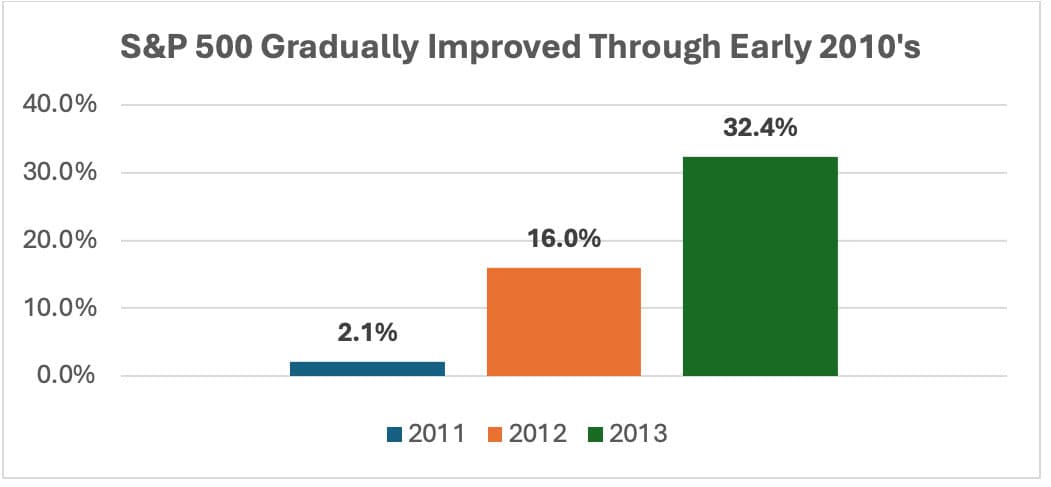
U.S. equity markets responded powerfully to the improving economic backdrop. The S&P 500 rose approximately 32% in 2013, its strongest annual performance since the late 1990s. The Dow Jones Industrial Average gained roughly 27%, while the Nasdaq Composite surged nearly 38%.
Unlike some prior rally periods, gains were broad-based. Cyclical sectors such as consumer discretionary, financials, and industrials led the market, reflecting optimism around consumer spending, credit availability, and business investment. Financial stocks benefited from a steeper yield curve and improving balance sheets, while consumer-oriented companies were supported by rising employment, improving wages, and higher household net worth driven by recovering home prices and equity markets.
Valuations expanded meaningfully during the year as investors became more willing to pay higher multiples amid reduced fears of recession. While this raised longer-term valuation questions, it reflected a market recalibrating risk perceptions rather than excessive speculation.
Bonds Face Headwinds as Rates Rise
Fixed income markets experienced a more challenging year. Rising interest rates weighed on bond prices, and the Bloomberg U.S. Aggregate Bond Index declined approximately 2% for the year.
Despite these losses, bonds continued to play an important role in diversified portfolios. Income remained steady, and bonds helped cushion portfolios during periods of equity volatility, particularly during the mid-year policy-driven selloff. The experience reinforced the importance of managing interest rate risk rather than abandoning fixed income altogether.
Housing and Employment Strengthen the Recovery Narrative
Another important driver of investor confidence in 2013 was improvement in key areas of the real economy. The housing market continued to recover, with home prices rising meaningfully across many regions and foreclosure activity declining. Construction activity increased, supporting related industries and employment.
Labor market conditions also improved steadily. Job creation became more consistent throughout the year, and the unemployment rate declined. These trends supported consumer confidence and spending, reinforcing the perception that the recovery was becoming self-sustaining rather than dependent solely on extraordinary policy support.
Investor Sentiment Shifts Meaningfully
Perhaps the most important change in 2013 was psychological. After years of crisis-driven behavior, investors gradually re-engaged with risk assets. Cash balances declined, equity allocations increased, and market participation broadened as confidence improved.
This shift did not occur without hesitation. Periods of volatility, particularly around monetary policy, reminded investors that markets remained sensitive to policy signals. Yet each pullback was met with renewed buying interest, reinforcing the market’s upward momentum and improving sentiment.
Looking Back at 2013
By the end of 2013, markets reflected a clear change in tone. Confidence replaced caution, and investors were rewarded for patience and discipline. The year underscored an enduring lesson: markets often move strongest when investors are still uncertain, not when optimism is fully entrenched. For long-term investors, 2013 marked the beginning of a new phase in the post-crisis market cycle.