


A Year of Political Shock, Market Resilience, and Shifting Expectations
At first glance, 2016 appeared destined to be a difficult year for investors. Markets opened the year under pressure as concerns over global growth, collapsing energy prices, and tightening financial conditions triggered a sharp selloff. Volatility spiked early, and confidence was fragile. Yet as the year progressed, markets repeatedly demonstrated resilience, absorbing political shocks and economic uncertainty while ultimately delivering solid returns.
What defined 2016 was not the absence of disruption, but the market’s ability to adapt. Investors were reminded that markets often move ahead of clarity, and that fear-driven periods can give way to opportunity with surprising speed.
Early-Year Turbulence Tests Investor Confidence
The year began with a sharp bout of volatility. In January and February, global equity markets sold off amid fears of slowing growth in China, a collapse in oil prices, and concerns that the Federal Reserve’s first rate hike in nearly a decade had come too soon. The S&P 500 fell more than 10% from its prior highs, while energy stocks declined sharply as oil prices briefly fell below $30 per barrel.
Credit markets also showed signs of stress, particularly in energy-related issuers. Headlines surrounding global recession risks dominated investor sentiment, and many questioned whether the long economic expansion was nearing its end.
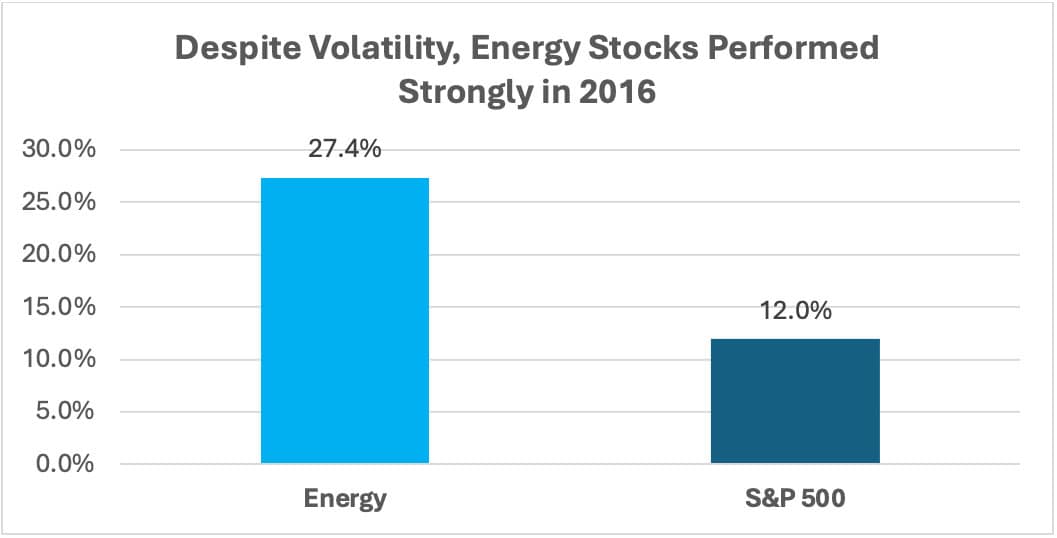
However, conditions stabilized by late winter. Oil prices began to recover, fears of an imminent recession eased, and central banks signaled a willingness to remain supportive. Markets rebounded sharply from their early-year lows, illustrating how quickly sentiment can shift.
Central Banks Anchor Markets
Monetary policy played a critical role in stabilizing markets throughout 2016. While the Federal Reserve had raised interest rates in December 2015, it adopted a cautious approach for much of the year as global risks mounted. Policymakers emphasized patience and data dependence, easing concerns that tightening would accelerate too quickly.
Outside the U.S., central banks remained highly accommodative. The European Central Bank and the Bank of Japan expanded stimulus efforts, helping support global liquidity and reduce downside risks. This coordinated support helped calm markets and reinforced confidence that policymakers would respond to economic weakness if necessary.
For investors, this environment reduced uncertainty and allowed risk assets to recover from early-year stress.
Political Surprises Drive Volatility—but Not Derailment
Few years featured as many political surprises as 2016. The United Kingdom’s vote to leave the European Union shocked markets in June, triggering a sharp but short-lived selloff. Global equities declined quickly, but recovered within weeks as fears of systemic disruption failed to materialize.
Later in the year, the U.S. presidential election produced another unexpected outcome. Initial market reactions were volatile, but sentiment shifted rapidly as investors focused on the potential for fiscal stimulus, tax reform, and deregulation.
These political events underscored an important theme of the year: while headlines generated volatility, markets consistently refocused on economic fundamentals and forward-looking expectations.
Equity Markets Finish Strong
Despite multiple periods of volatility, equity markets delivered positive returns in 2016. The S&P 500 gained approximately 12% for the year, while the Dow Jones Industrial Average rose about 13.4%. The Nasdaq Composite posted a more modest gain of roughly 7.5%, reflecting uneven performance within technology stocks.
Leadership rotated meaningfully over the course of the year. Defensive sectors performed well early, while cyclical areas such as financials and industrials gained momentum late in the year following the U.S. election. Value-oriented stocks outperformed growth in the second half, reversing a multi-year trend and highlighting how quickly market leadership can change.
International markets experienced mixed results, with currency movements and political uncertainty playing a larger role in returns.
Bonds Provide Stability Amid Uncertainty
Fixed income markets played an important stabilizing role in 2016. Bond prices rose during periods of equity stress, particularly early in the year and following the Brexit vote. The 10-year Treasury yield declined to historic lows near 1.4% during the summer before rising modestly later in the year.
Core bond indices delivered positive returns, supported by declining yields and steady income. While yields remained low, bonds continued to provide diversification benefits and helped offset periods of equity volatility.
Looking Back at 2016
By the end of 2016, investors had navigated a year filled with uncertainty, surprises, and shifting expectations. Markets demonstrated resilience in the face of political and economic shocks, reinforcing the importance of maintaining perspective during volatile periods. The year served as a reminder that uncertainty does not preclude positive returns—and that staying disciplined during periods of stress often proves rewarding over time.