


A Year of Confidence, Calm, and Steady Market Progress
In many ways, 2017 stands out as one of the calmest and most consistent market environments of the post-financial-crisis era. Investors entered the year facing political uncertainty, questions around global trade, and skepticism about whether the long economic expansion could continue. Instead of disruption, markets were met with steady economic growth, supportive policy, and improving corporate fundamentals.
Rather than reacting to shocks, investors spent much of the year growing more confident that the expansion could persist. Volatility remained unusually low, and market pullbacks were brief and shallow. For long-term investors, 2017 reinforced the value of staying invested during periods when uncertainty dominates headlines but fundamentals remain intact.
Global Economic Growth Broadens and Strengthens
One of the most important drivers of market performance in 2017 was the broad improvement in global economic growth. In the United States, economic activity remained steady, supported by rising consumer confidence, strong employment growth, and resilient consumer spending. The unemployment rate fell toward 4.1% by year-end, the lowest level in nearly two decades.
Internationally, conditions improved meaningfully. Europe experienced its strongest growth in years, supported by accommodative policy and improving business sentiment. Emerging markets also benefited from a stable U.S. dollar and stronger global demand. This synchronized growth environment helped lift corporate revenues and earnings across regions, reinforcing investor confidence.
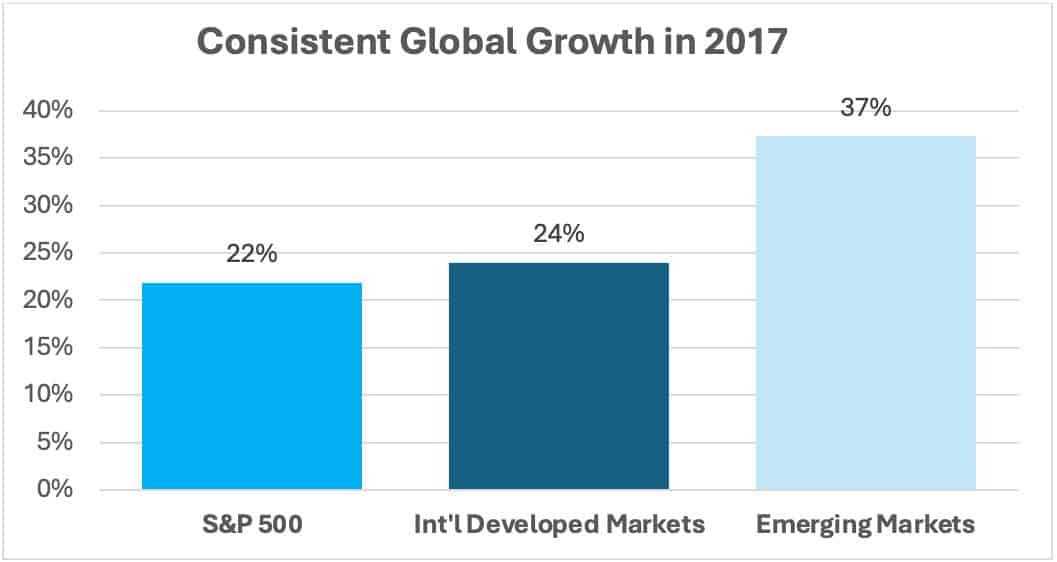
For markets, the key takeaway was that economic growth was no longer narrowly concentrated in the U.S., reducing fears that global weakness could derail the expansion.
Equity Markets Advance with Unusual Consistency
Equity markets delivered strong and remarkably steady returns in 2017. The S&P 500 gained approximately 21.8% for the year. The Nasdaq Composite advanced roughly 28%, led by technology and growth-oriented companies that continued to deliver strong earnings growth.
What made 2017 unique was not just the strength of returns, but the lack of volatility along the way. The S&P 500 did not experience a single drawdown of 5% or more during the entire year, an extremely rare occurrence. Market declines were typically short-lived, reinforcing confidence among investors and reducing emotional decision-making.
Gains were relatively broad-based. Technology stocks led, but financials, industrials, and consumer discretionary companies also contributed meaningfully. Small-cap stocks posted positive returns as well, though they lagged larger companies amid muted inflation and moderate interest rates.
Central Banks Provide Stability Rather Than Surprise
Another defining feature of 2017 was the predictable and measured approach taken by central banks. The Federal Reserve raised interest rates three times during the year, but these moves were well-communicated and largely anticipated by markets. Importantly, policymakers emphasized that policy remained accommodative, helping prevent concerns that tighter conditions might choke off growth.
Bond yields rose modestly, with the 10-year Treasury yield ending the year near 2.4%. While yields remained low by historical standards, the gradual increase reflected confidence in economic momentum rather than inflationary pressure.
This stable policy backdrop reduced uncertainty and allowed investors to focus more on fundamentals and less on macroeconomic risk.
Anticipation of Tax Reform Lifts Sentiment
As 2017 progressed, expectations around U.S. tax reform became an increasingly important driver of market optimism. Investors anticipated that lower corporate tax rates could support higher earnings, increased capital investment, and stronger cash flows. While the Tax Cuts and Jobs Act was not signed into law until late December, markets began pricing in these expectations well in advance.
Domestically focused companies, particularly those with higher effective tax rates, benefited from improved sentiment. This optimism contributed to late-year equity strength and reinforced confidence heading into 2018.
Fixed Income Plays a Supporting Role
Fixed income markets delivered modest returns in 2017, reflecting a stable interest rate environment. Bond yields rose gradually, limiting price appreciation, but bonds continued to provide income and diversification benefits. Credit markets remained healthy, supported by solid corporate balance sheets and low default rates.
While bonds did not generate outsized returns, they contributed to overall portfolio stability during a year when equities steadily advanced.
Looking Back at 2017
By the end of 2017, investors had experienced a year defined by confidence, consistency, and calm. Strong equity returns, improving global growth, and predictable policy created an environment that rewarded discipline and patience. In hindsight, the tranquility of 2017 stands in sharp contrast to the volatility that would follow, serving as a reminder that extended periods of stability can often precede significant market transitions.