



Taxes can feel like a thorn in the side of every investor, but they’re an essential part of managing your portfolio. Whether you’re invested in common stocks, corporate bonds, or other assets, it’s important to know how taxes will affect your returns. While you should always consult your tax advisor prior to investing, let’s analyze the different types of taxes, the events that trigger them, and some of the strategies you can use to minimize the bite Uncle Sam takes from your hard-earned money.
Capital Gains vs. Ordinary Income: The Two Big Tax Buckets
When it comes to investment taxes, there are two primary categories you need to worry about: capital gains and ordinary income.
- Capital Gains: These are the profits you make when you sell an investment for more than you paid for it. If you sell the asset in less than a year, you’ll be hit with the short-term capital gains rate, which is the same as your regular income tax rate (up to 37% for high earners). If you’ve held the asset for more than a year, you’ll be taxed at the long-term capital gains rate, which is generally lower (0%, 15%, or 20%, depending on your income).
- Ordinary Income: This includes things like interest from corporate bonds or the portion of dividends that aren’t “qualified.” Qualified dividends are taxed at a lower capital gains rate, while unqualified dividends, along with interest from corporate bonds, are taxed at ordinary income rates.
Taxable events–like selling a stock or bond, or receiving dividends or interest–trigger these taxes. Understanding the classification of your income can make a significant difference in how much you owe the IRS.
Stocks and Bonds: What Triggers Taxes?
Now, let’s break down what happens with two of the most common types of investments–stocks and bonds.
- Common Stocks: With stocks, taxes generally come into play when you sell your shares. If your stock has appreciated, the gain will either be long-term or short-term, depending on how long you’ve held it. Dividends also matter. Qualified dividends (paid by U.S. corporations or qualified foreign corporations) are typically taxed at long-term capital gains rates, while non-qualified dividends are taxed as ordinary income.
- Corporate Bonds: Bonds can be a little more straightforward. The interest they pay is taxed as ordinary income, whether you reinvest it or not. If you sell a bond before it matures, you could also face capital gains or losses, depending on the price difference from when you bought it.
- Treasury Bonds: The interest from U.S. Treasury bonds is exempt from state and local taxes, but it’s still subject to federal tax. This can be a nice tax-saving edge if you live in a high-tax state like California or New York.
Tax-Loss Harvesting: Your Portfolio’s Secret Weapon
 One of the best ways to minimize your tax bill is through tax-loss harvesting. This strategy involves selling losing investments to offset the gains from winners, reducing the amount of capital gains tax you owe. If you have more losses than gains, you can even use up to $3,000 of those losses to offset ordinary income each year. Any additional losses can be carried forward to future years.
Here’s a hypothetical example to illustrate this: Let’s say you’re a high-earner in the 37% tax bracket, and you’ve made $100,000 in short-term capital gains from stock trades this year. However, you also have $40,000 in losses from a few underperforming stocks. By selling those losers, you can offset your taxable gains, leaving you with only $60,000 in gains. That can save you a significant amount in taxes. If you have more losses than gains, you can carry the excess into the next tax year and keep reducing your future tax liability.
How Dividends Affect Your Tax Bill
Dividend-paying stocks are a great source of income for many investors, but they come with their own set of tax considerations.
- Qualified Dividends: These are dividends from U.S. companies or qualified foreign companies, and they’re taxed at the same lower rates as long-term capital gains (0%, 15%, or 20%).
- Non-Qualified Dividends: These are taxed as ordinary income, so if you’re in a higher tax bracket, you could be paying as much as 37% on these payouts.
This difference in tax treatment is one reason why many investors prefer stocks with qualified dividends–you keep more of your money, especially if you’re in a higher tax bracket.
Hypothetical Investor Example: John the High-Earner
Let’s say John is a high-earner with an income of $500,000 per year, putting him in the 35% tax bracket. John has a portfolio of stocks, bonds, and mutual funds. This year, he made $50,000 in capital gains and received $20,000 in dividends, of which $15,000 were qualified.
Here’s how taxes would affect John:
- Qualified Dividends: John’s $15,000 in qualified dividends would be taxed at the capital gains rate of 15%.
- Non-Qualified Dividends: His $5,000 in non-qualified dividends would be taxed as ordinary income, at 35%.
- Capital Gains: John’s $50,000 in capital gains would be subject to the long-term capital gains rate of 15%, assuming he held the stocks for more than a year.
Exhibit 1 below illustrates the capital gains tax rates for individuals with varying levels of income:
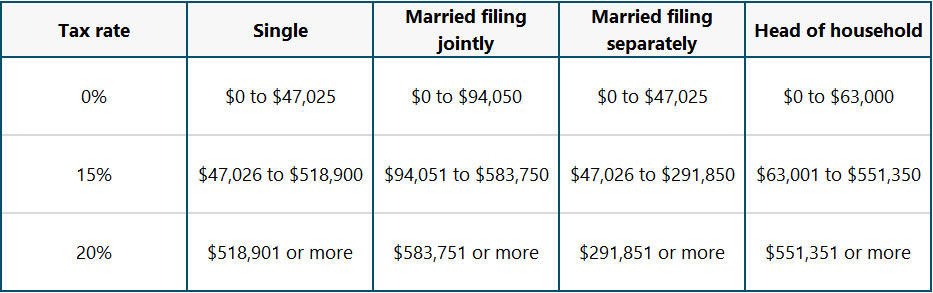
Exhibit 1: Source (IRS, tax year 2024)
Tax-Avoidance Strategies: Beyond Tax-Loss Harvesting
There are other strategies investors can use to minimize taxes, including:
- Holding investments for over a year: This ensures you pay the lower long-term capital gains rate rather than ordinary income rates.
- Maximizing contributions to tax-advantaged accounts: By contributing the maximum to your 401(k), IRA, HSA, or other tax-deferred accounts, you can defer taxes on your investment gains until retirement, when you may be in a lower tax bracket.
Conclusion
Taxes can have a substantial impact on your investment returns, but with the right strategies, you can minimize that impact and keep more of your hard-earned money. Understanding how different types of investments are taxed–and how to take advantage of opportunities like tax-loss harvesting and tax-advantaged accounts–can help you build a more tax-efficient portfolio. It’s not about avoiding taxes altogether, but about making sure you’re not paying more than you have to. It is worth noting that tax laws can be changed at any time and without notice.
Tax planning may not be the most exciting part of investing, but it’s one of the most important. After all, it’s not just about what you make – it’s about what you keep.
Related Articles

What Are Phantom Taxes?
Index Investing,
November 2, 2023

Tax-Efficient Investing Strategies
Personal Finance,
Tax,
July 11, 2024

Comparing the Tax Efficiency of Mutual Funds, ETFs, and Institutional Money Managers. Which should you choose?
Index Investing,
Indexing for the Affluent,
Personal Finance,
Top Personal Finance FAQs,
September 17, 2024