

Imagine planting a tiny acorn in the ground. At first, it doesn’t look like much. But if you water it, give it sunlight, and wait patiently, it can grow into a big oak tree one day. And once the oak tree becomes a mature, adult oak tree, it then sheds its own acorns which fall back to the ground. Some of those new acorns get buried in the ground naturally, take root and themselves grow into large, mature trees. Given enough time, that one acorn can give life to a whole forest. All from one initial acorn to get things started. So, the fundamental principles of growing trees is plant, harvest and re-plant, as demonstrated below.
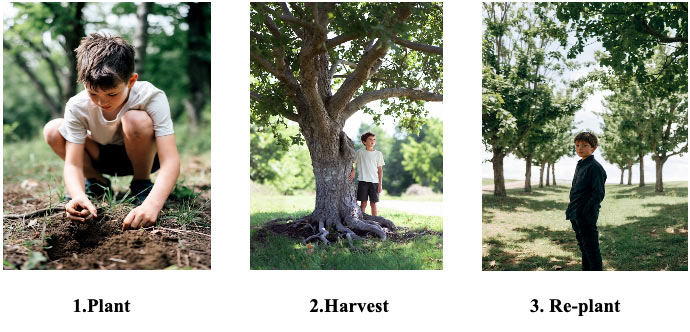
Investing works in much the same way, but with money. You start with a small amount of money, take good care of where and how you invest it, and over time it can grow into something much bigger – giving you more money in return. Over time, all the money your investments make for you can themselves be re-invested in other investments, which also pay you money. And just like the acorn grows into a forest, your money can grow into a large investment portfolio over time. And like the principles of growing trees, the principles of growing money are invest, harvest and re-invest, as illustrated below.
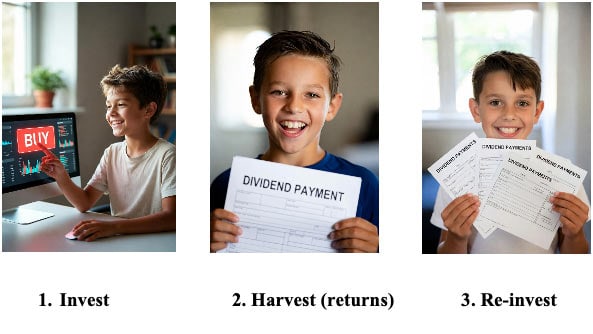
When the stocks and bonds that you own pay you money, it is called dividends, coupons, or interest earned. In general, whatever form the money takes, when they pay you back it can simply be called “returns” – because the company behind the security pays money back to you. “Returns” is commonly used in the investment business because it helps you figure out how well (or poorly) you did in a given investment, and to compare that with other investments, or groups of investments.
Where Theory Meets Reality
Don’t let the big, fancy words thrown around in the investment world scare you. While there are many new concepts and dynamic events that occur in financial markets; the basic principles of investing – which are important to everyone who wants to achieve financial freedom – are not beyond your reach. Consider if you worked around the neighborhood mowing lawns, or babysitting, for your neighbors and were able to save $1,000. Let’s say you then invested that money in shares of a company called Microsoft (which owns Windows, Xbox, Copilot and a variety of other products and services). If you had invested your $1,000 in shares of Microsoft stock in, say January of 2010, for about $28 per share (denoted by the “1” on the chart below). Today, those Microsoft shares would be worth over $400 per share (denoted by the “2” on the chart below).
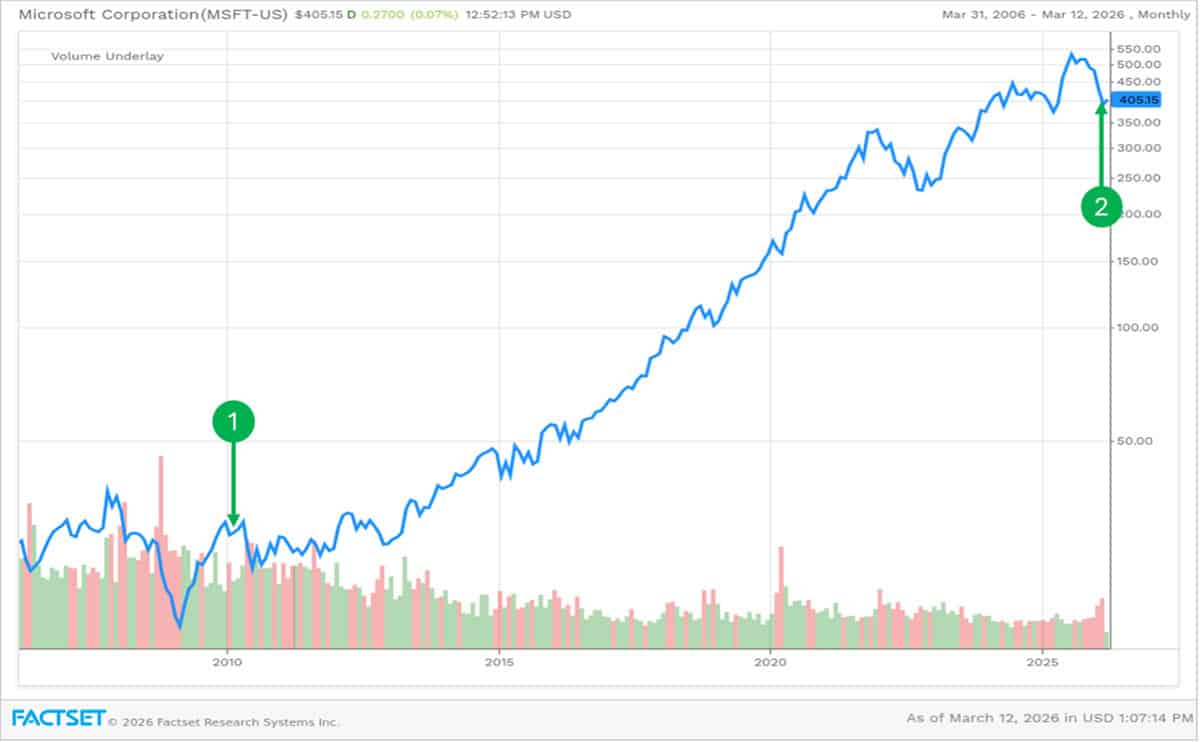
This means that when you include the growth in the stock price and all the dividends earned, your initial $1,000 investment in Microsoft would have turned into over $15,000 by March of 2026, as illustrated in the table below:
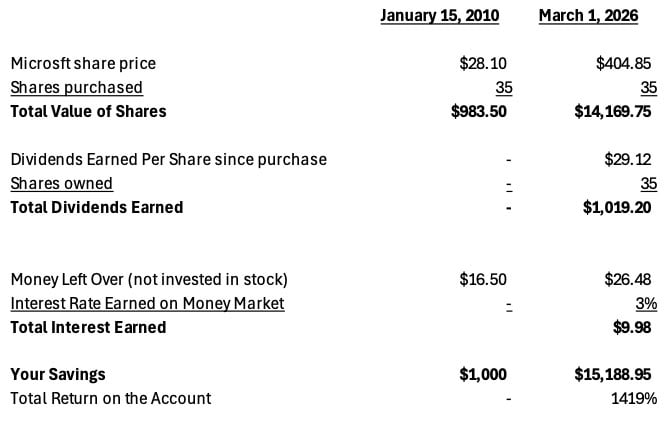
In the meantime, you go about your life and let the team at Microsoft works for you. In the real world you have to weigh and consider a wide variety of competing interests, risks to your investments, an understanding of your own needs, as well as external events that you cannot control like wars, recessions, market scares, and so forth. Nevertheless, what you’ve learned here is one of the most powerful secrets not only in investing, but in life. By investing your money wisely when you are young, you can empower your money to work for you so that some day, you only have to work if you choose to work. That is freedom. And it is priceless. So, be prudent on your journey, invest your money wisely, spread risk across many investments and let the magic of compounding work for you. And begin your journey toward financial freedom.