


Treasury Inflation-Protected Securities (TIPS) are a unique category of U.S. government bonds designed to safeguard investors from inflation. These securities offer a reliable way to preserve purchasing power while benefiting from the backing of the U.S. Treasury.
What Are TIPS?
TIPS are government-issued bonds whose principal value adjusts with inflation as measured by the Consumer Price Index (CPI). While traditional bonds offer fixed interest payments, the unique feature of TIPS is their inflation adjustment:
- Principal Adjustments: The face value of TIPS increases with inflation and decreases with deflation. This adjustment ensures the investor’s real return remains protected against rising prices.
- Interest Payments: The semi-annual interest payments are calculated based on the adjusted principal, meaning that as inflation increases the bond’s value, the interest payments grow as well.
- Maturity: At maturity, investors receive either the inflation-adjusted principal or the original principal, whichever is higher. This feature protects against possible deflation during the bond’s term.
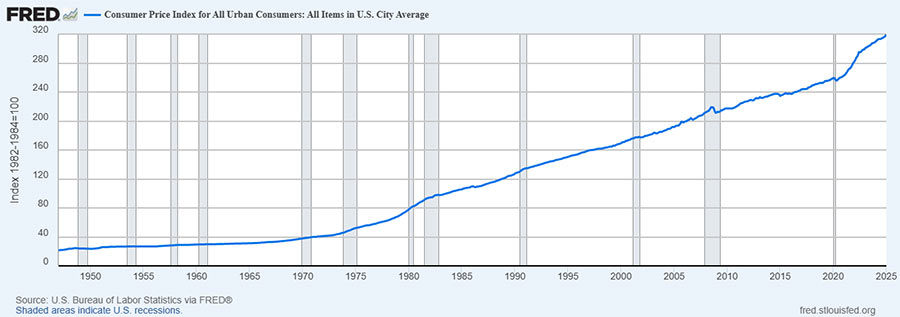
Inflation has reared its head in recent years, increasing the popularity of these securities. Until 2021, many investors hadn’t seen significant inflation since the early 1980s. Take a look at how the CPI has increased over time:
How Do TIPS Work?
TIPS adjustments are specifically tied to the Consumer Price Index for All Urban Consumers (CPI-U), a standard measure of inflation that reflects changes in the cost of goods and services purchased by urban households. For example:
- Initial Purchase: You purchase TIPS with a $1,000 face value.
- Inflation Adjustment: If inflation rises by 3%, the principal adjusts to $1,030.
- Interest Payment: If the interest rate is 1%, the semi-annual payment is calculated on the new $1,030 principal, yielding $5.15 (half of 1%).
- Deflation Scenario: If the CPI decreases, the principal adjusts downward, but the U.S. Treasury guarantees repayment of the original principal at maturity, ensuring no capital loss in nominal terms. Given the Federal Reserve’s target of ~2% inflation, the CPI decreasing is improbable.
Advantages of TIPS
- Inflation Protection: The most significant benefit is the automatic adjustment of the principal to inflation, preserving your purchasing power.
- Low Credit Risk: Backed by the U.S. government, TIPS carry minimal credit risk.
Disadvantages of TIPS
- Lower Yields: Compared to traditional bonds, TIPS often offer lower initial yields due to their inflation protection feature.
- Tax Implications: Outside of tax-advantaged accounts, both the inflation adjustments and interest payments are taxable in the year they occur, even if you don’t sell the bond. This phenomenon, called “taxable phantom income,” can reduce their after-tax appeal. However, TIPS are exempt from state and local taxes.
- Deflation Risk: While TIPS protect against inflation, their value may not grow if deflation persists, limiting their upside compared to other investments.
How to Invest in TIPS
Investors can access TIPS in several ways:
- Direct Purchase: TIPS can be purchased directly from the U.S. Treasury through TreasuryDirect in increments of $100.
- Mutual Funds and ETFs: Some funds specialize in TIPS, offering exposure to a diversified portfolio of inflation-protected securities. However, pooled investment vehicles like mutual funds and ETFs have their own disadvantages.
- Secondary Market: TIPS can also be bought and sold on the secondary market, though their prices may fluctuate with market conditions.
Should You Invest in TIPS?
TIPS are particularly suited for investors who:
- Want to hedge against rising inflation.
- Have long-term financial goals where preserving purchasing power is crucial.
- Are looking for low-risk assets backed by the U.S. government.
However, for those seeking higher yields or willing to accept greater risk for potentially higher returns, TIPS may not be the optimal choice. Treasury Inflation-Protected Securities offer a unique way to protect against inflation, providing a reliable option for conservative investors or those with long-term financial goals. By understanding how TIPS work and their role in a diversified portfolio, investors can make informed decisions about incorporating these bonds into their financial strategy.