



By Indexopedia Research Team | October 21, 2024 | In
How a 1000-Point Drop in the Dow Jones Industrial Average is Perceived Over Time: A Shifting Investor Landscape
Twenty years ago, the thought of a 1,000-point drop in the Dow Jones Industrial Average (DJIA) would have sent shockwaves through the investment world. Such a steep decline would have triggered panic among investors, news outlets would have broadcasted round-the-clock coverage, and financial experts would have rushed to provide their takes on the imminent economic fallout. Today, however, a 1,000-point drop, while still significant, doesn’t evoke the same level of alarm or urgency. The market’s sheer size, scale, and resilience have recontextualized what once seemed like a catastrophic decline into a more routine occurrence.
The Changing Significance of a 1,000-Point Drop
20 Years Ago: A Market Shake-Up
Let’s take a trip back to the early 2000s, when the Dow Jones hovered around 10,000 points. At that time, a 1,000-point drop would have represented a massive 10% loss in value, triggering immediate and widespread fear. The DJIA experienced one of these seismic moves in the aftermath of the September 11, 2001, terrorist attacks. The market reopened after a four-day closure, and the Dow fell 684 points in a single day, the largest point drop in history at the time. Investors panicked, and the headlines reflected the anxiety, with phrases like “Market Meltdown” and “Historic Collapse.” While the actual percentage drop was around 7%, the psychological impact of such a sharp decline in points resonated deeply across the financial landscape.
To add another perspective, the Dot-com crash that occurred in the early 2000s saw the DJIA drop several hundred points at a time on numerous occasions. Even if these declines didn’t always exceed 1,000 points in a single day, they had a similar effect on investor psyche. With the Dow at lower levels, each percentage drop felt sharper and more significant, leaving many retail investors wary of re-entering the market. After all, losing 1,000 points on a 10,000-point Dow can mean wiping out years of slow, hard-fought gains.

Today: A Drop in the Bucket?
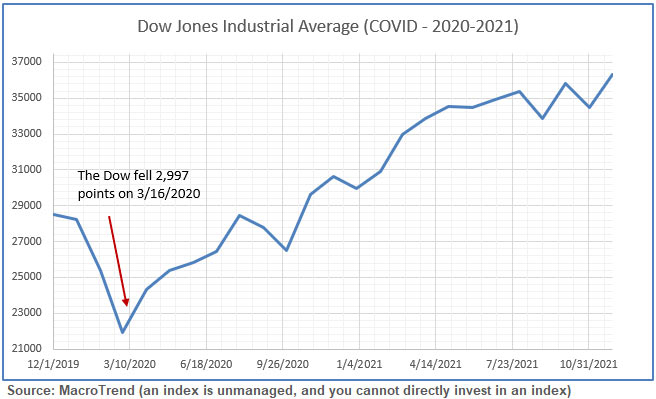
Fast forward to today, and the DJIA often fluctuates between 33,000 and 35,000 points. A 1,000-point drop represents closer to a 3% movement in the index. While such a move still grabs headlines and prompts discussions about market sentiment, it doesn’t stir the same level of fear that it once did. Take, for example, the market turmoil in March 2020, during the height of the COVID-19 pandemic. On March 16, 2020, the Dow suffered a staggering 2,997-point decline–the largest point drop in history. While the scale of the drop was unprecedented in point terms, the percentage decline was around 12%, a significant but not unheard-of drop. Despite the fear and panic that accompanied this crash, the market rebounded in a matter of months, regaining lost ground and then some.
To compare, a 1,000-point drop today would barely be a third of what occurred on that single day in March 2020. Furthermore, even though it would still draw attention, seasoned investors now recognize that these types of fluctuations are part and parcel of a dynamic, globalized market. Instead of panicking and selling off their portfolios, many investors today take these drops in stride, looking at them as buying opportunities rather than moments of financial calamity.
The Dow’s Growth and Investor Perception
The reason why a 1,000-point drop has become less alarming is simple: the Dow Jones Industrial Average has grown exponentially in value. In 1999, the Dow surpassed 10,000 points for the first time. By 2021, it had soared past 35,000, and as of 2024, it’s fluctuating in that same range. As the Dow has risen, the significance of point movements has diminished. A 500-point or even 1,000-point drop has less overall impact in percentage terms than it did when the index was far lower.
For instance, when the Dow first crossed 10,000, a 1,000-point drop represented a 10% decline, as we mentioned earlier. Today, with the Dow at around 34,000 points, that same drop equates to less than 3%. This shift in scale has redefined how investors interpret market fluctuations. A 1,000-point drop is no longer perceived as catastrophic; rather, it’s considered a part of the natural ebb and flow of a large, dynamic market.
Historical Examples
Let’s look at a few key historical drops to emphasize this changing perception:
- Black Monday (October 19, 1987): The Dow dropped 508 points, which was a 22.6% decline in a single day. While this drop is often remembered by its percentage decline rather than its point value, it’s crucial to understand that a similar percentage drop today would equate to more than 7,000 points!
- The Financial Crisis (2008): On September 29, 2008, the Dow fell 777 points, a record point drop at the time, equating to a 7% decline. This drop was triggered by Congress’s failure to pass the initial bank bailout package. Panic swept the markets, with global repercussions. Even though 777 points was far less than what we’ve seen in more recent years, the underlying financial crisis amplified the market’s reaction.
- COVID-19 Pandemic (March 2020): As mentioned, the Dow plummeted nearly 3,000 points in a single day. While the point value was staggering, the percentage decline was 12%, making it comparable to previous market crashes. The response to the pandemic’s market effects underscored the resilience of modern investors, as many took advantage of the dip to buy discounted shares, anticipating a recovery.
Exhibit 1
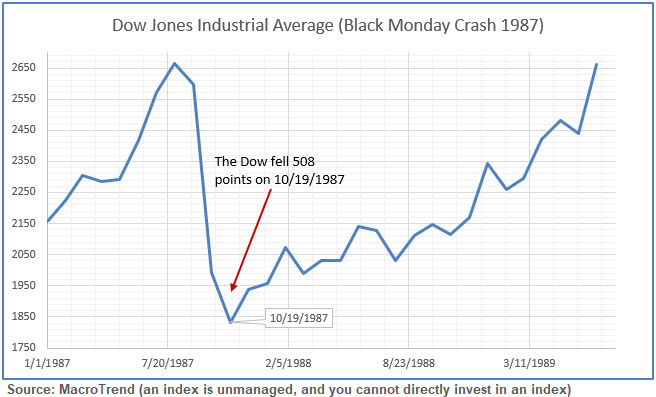
Exhibit 2
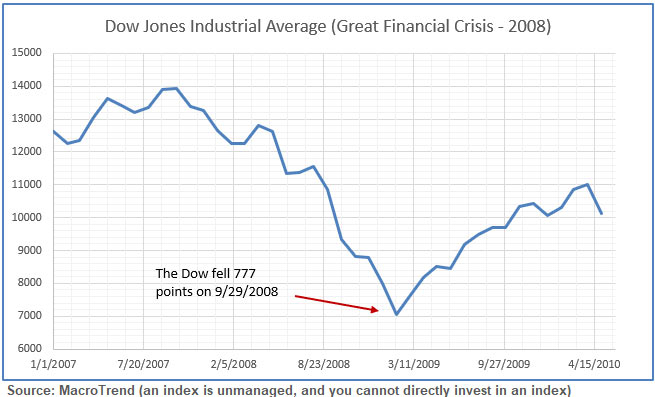
Exhibit 3
The Modern Investor: Resilience and Perspective
So, what’s changed? In addition to the Dow’s sheer size, modern investors are armed with more information and better tools for analyzing market volatility. The widespread use of algorithmic trading, exchange-traded funds (ETFs), and robo-advisors allows for automatic rebalancing and faster response times. Investors are more accustomed to riding out market turbulence and have been conditioned to see drops as opportunities rather than signs of impending doom.
Moreover, financial media has shifted to providing more data-driven analysis. While headlines can still scream “Dow Drops 1,000 Points!”, there’s more context around what that drop means in real terms. A 3% decline is notable, but it’s not the type of loss that typically leads to a market-wide panic anymore.
Conclusion: Perspective in a Larger Market
A 1,000-point drop in the Dow Jones Industrial Average isn’t what it used to be. As the Dow has climbed, point-based drops have become less significant in percentage terms, leading to less panic and more measured reactions from investors. While large drops always attract attention, the modern investment landscape–with its higher levels of liquidity, data accessibility, and sophisticated trading mechanisms–has made these fluctuations more tolerable, if not entirely routine.
As we illustrate these shifts in investor sentiment through historical examples and visual data (see the accompanying charts), it becomes clear that the markets have grown in ways that were unimaginable 20 years ago. Today, savvy investors recognize that a single-day drop, even of 1,000 points, is just one moment in a long-term investment journey.
Related Articles

How do Index Funds Perform During Down Markets?
Index Investing,
Top Index FAQs,
January 8, 2025

How Down Markets Can Actually Benefit Investments in Bonds and Dividend Stocks
Behavior,
Fixed Income,
Investment Principles,
Markets,
Why to Buy & Where,
August 14, 2024

How does FOMO negatively impact my investment results?
Investment Principles,
Personal Finance,
Top Investor Mistakes,
Top Personal Finance FAQs,
January 8, 2025