


Not many investors give much thought to their after-tax returns. Yet, over long periods, not planning for taxes can erode portfolio performance — just as much as fees or poor timing. In fact, poor tax planning can cost investors around 1% per year.
One particular solution is gaining popularity: direct indexing.
In addition to customization and transparency, one of the biggest advantages of direct indexing is tax-loss harvesting at the individual security level. By owning the underlying stocks of an index rather than a single fund, investors can potentially turn everyday market volatility into a source of tax efficiency, without materially changing their long-term market exposure.
Let’s explore how it works.
What Is Direct Indexing?
It’s a fairly simple concept. Instead of owning a single mutual fund or ETF that tracks an index, you own the individual stocks within that index.
For example, you own an S&P 500 fund. Inside that fund, the manager holds shares of the 500 or so constituents that make up the index. As an investor, you own a slice of the fund, not the company shares themselves.
Direct indexing “unwraps,” so to speak, that bundle of companies. Instead of buying shares of a fund, you buy shares of the companies that comprise the index, with the goal of mirroring the index’s overall performance. It’s like an ETF designed for one person — the primary difference is control.
This structure opens the door to several benefits:
- More precise tax management. Individual holdings can be sold selectively to realize losses or manage gains.
- Customization. Investors can tilt toward certain factors, exclude specific companies or industries, or tweak holdings according to their broader investment strategy.
- Transparency. You can see exactly what you own, whereas an ETF or mutual fund may only share top holdings.
What Is Tax-Loss Harvesting?
Tax-loss harvesting is the process of selling investments that are currently down to realize a loss, then reinvesting the proceeds into similar but substantially different securities to maintain exposure. Those realized losses can be used to offset capital gains elsewhere in your portfolio, and in some cases, reduce ordinary income as well.
A few key points to understand:
- Losses are only “real” for tax purposes once they’re realized. An investment that’s down on paper doesn’t affect your taxes until it’s sold.
- Harvested losses can offset gains dollar-for-dollar. If you realize $25,000 in long-term capital gains and $25,000 in long-term capital losses, the gains may effectively be neutralized.
- Unused losses aren’t wasted. If losses exceed gains in a given year, up to $3,000 can be used to offset ordinary income, with the remainder carried forward to future years.
Importantly, tax-loss harvesting isn’t about timing the market or abandoning investments you believe in. The goal is to capture losses as they occur, then reinvest so your portfolio stays aligned with its long-term strategy.
With a traditional index fund or ETF, tax-loss harvesting is limited by the movements of the fund itself. With direct indexing, losses can be harvested at the individual stock level, creating far more opportunities to capture tax benefits during normal market fluctuations.
Why Direct Indexing Makes Tax-Loss Harvesting More Powerful
Maximizing Opportunities
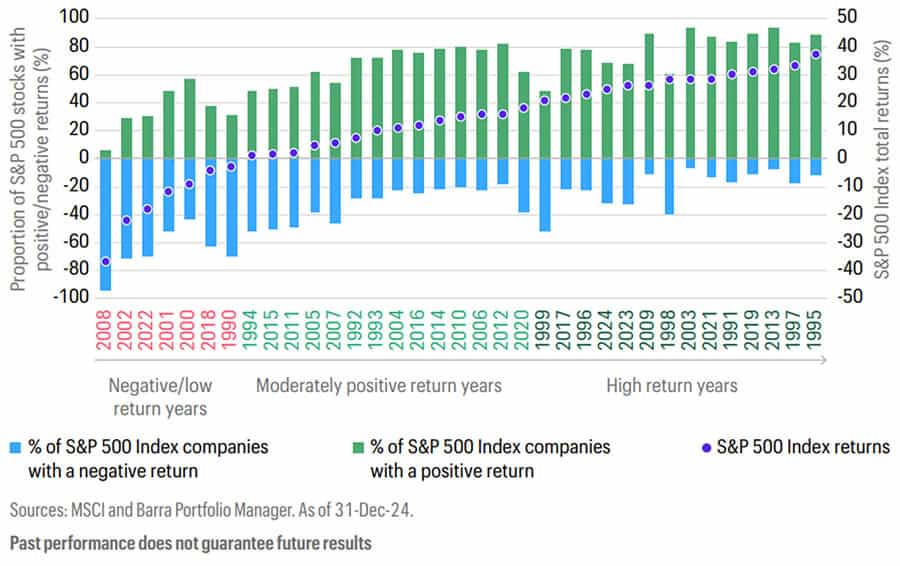
Markets are inherently chaotic and unpredictable. Even during extended bull runs, the prices of individual companies are constantly moving for company-specific reasons (e.g., earnings misses, sector rotations, management changes, short-term news).
With direct indexing, some companies will inevitably trend upward while others trend downward. Those declines could be harvested, even when the overall market is positive.
With an ETF, you must wait until the entire fund is below its cost basis, which could conceivably never happen after a strong market run.
Maintaining Market Exposure
A common concern is whether selling stocks to harvest losses disrupts portfolio exposure.
Once a loss is harvested, the proceeds are then reinvested immediately into a similar security or basket of securities that maintain comparable exposure (e.g., selling Coca-Cola and buying Pepsi), while respecting IRS wash-sale rules. After 30 days, harvested positions can be repurchased.
Offsetting Major Gains
Over time, a direct indexing portfolio should systematically harvest losses during normal market fluctuations. Individually, these losses may seem relatively modest. Together, they can add up to a sizable “bank” of realized capital losses sitting patiently on your tax return.
It’s not unreasonable for an investor with a seven-figure portfolio to accumulate hundreds of thousands of dollars in harvested losses, with enough time.
Now fast-forward to a major liquidity event. Suppose a married couple sells a primary residence they’ve owned for decades and realizes a $750,000 gain. After applying the $500,000 capital gains exclusion, $250,000 is still taxable.
Without harvested losses, that remaining gain could generate $37,500 or even $50,000 in federal capital gains tax (15% and 20% rates, respectively), depending on income. Not to mention potential state taxes. If the couple has $250,000 of previously harvested capital losses, the entire taxable portion of the gain could be offset, dramatically reducing or even eliminating the federal tax bill.
The same logic applies to selling long-held company stock or inherited securities with a very low cost basis. For instance, an executive sells $1 million of long-held company stock with an $800,000 gain. Without planning, that gain could easily trigger six figures in combined federal and state taxes.
But years of systematic tax-loss harvesting can offset a substantial portion of that gain, mitigating the tax impact and preserving more of the proceeds.
Who Benefits Most from Tax-Loss Harvesting via Direct Indexing?
Tax-loss harvesting through direct indexing isn’t a universal solution. Its value depends on an investor’s tax profile, portfolio size, and the types of gains they expect to realize in the future. For the right investor, however, the benefits can be life-changing.
In general, direct indexing tends to be most effective for investors with:
- Large taxable portfolios, where owning hundreds of individual securities provides more frequent opportunities to harvest losses
- Concentrated positions or anticipated capital gains, such as long-held company stock, real estate sales exceeding exemption thresholds, or other liquidity events
- Long time horizons, which allow harvested losses to accumulate and be used strategically over many years
That said, direct indexing is not without trade-offs. These strategies are usually run through an asset manager and, in turn, have higher minimum investment requirements and fees. And over time, as positions are harvested and repurchased, cost bases may reset at higher levels, which can gradually reduce the number of available loss-harvesting opportunities. The greatest benefits are often realized earlier in the life of the strategy or during periods of market volatility.
Direct indexing may be less compelling for investors who:
- Hold most assets in tax-deferred or tax-exempt accounts (IRAs, Roth IRAs, 401(k)s)
- Are in lower tax brackets
- Have relatively small taxable portfolios
In short, tax-loss harvesting via direct indexing works best for investors with meaningful taxes to manage. Paired with the right portfolio size, time horizon, and planning needs, it can be a powerful complement to a broader tax-aware investment strategy.
Related Articles

Who owns the stocks when I invest in index funds?
Index Investing,
Top Index FAQs,
October 16, 2024

Are Index Funds Tax Efficient?
Index Investing,
Top Index FAQs,
October 28, 2024

Institutional Indexing is Built for the Individual, Retail Indexing is Built for the Institution
Index Investing,
Indexing for the Affluent,
November 19, 2024