



The world of finance is built on the bedrock of various theories and models that guide investors in making informed decisions. One such model, the Capital Asset Pricing Model (CAPM), plays a significant role in determining the expected returns on investments and assessing the relationship between risk and reward. In this article, we will explore the key principles and components of CAPM and its importance in financial decision-making.
The Capital Asset Pricing Model, commonly known as CAPM, is a financial model developed by William Sharpe in the 1960s. It’s designed to provide a framework for calculating the expected return on an investment based on its risk and the broader financial market. CAPM offers a fundamental insight: the expected return on an investment should be directly linked to its systematic risk, also known as beta.
Key Components of CAPM
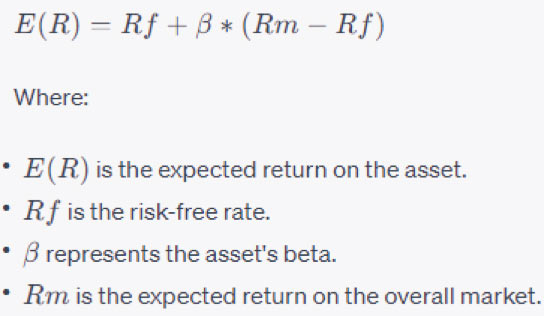
1. Risk-Free Rate (Rf)
The CAPM model begins with the assumption that there is a risk-free rate of return available to investors. This is typically represented by the yield on government bonds, such as U.S. Treasury bonds. It serves as the baseline return an investor could earn without taking on any risk.
2. Market Risk Premium (Rm – Rf)
The market risk premium represents the excess return investors can expect from investing in the overall market, beyond the risk-free rate. It accounts for the added risk of investing in equities as opposed to risk-free assets. The market risk premium is determined by subtracting the risk-free rate from the expected return on the market as a whole.
3. Beta (β)
Beta is a measure of an asset’s systematic risk. It reflects how sensitive an investment’s returns are to market movements. A beta of 1 means the asset moves in line with the market. A beta greater than 1 indicates higher volatility, while a beta less than 1 suggests lower volatility.
The CAPM Formula
The CAPM formula is straightforward and is used to calculate the expected return on a particular asset:
Importance of CAPM in Finance
1. Portfolio Management
CAPM is a vital tool for constructing diversified portfolios. It helps investors determine the ideal mix of assets based on their expected returns and risk profiles.
2. Investment Valuation
Investors can use CAPM to estimate the appropriate discount rate for valuing investments or assessing the attractiveness of potential projects.
3. Risk Assessment
CAPM aids in understanding the inherent risk of an investment by assessing its sensitivity to market movements. This is crucial for risk management.
4. Cost of Capital
Companies use CAPM to determine their cost of capital, which is critical for making investment decisions and capital budgeting.
The Capital Asset Pricing Model (CAPM) has been a cornerstone of modern finance for decades. It provides a structured framework for understanding how risk and return are interconnected in the world of investments. While it has its limitations and simplifications, CAPM remains a valuable tool for investors, financial analysts, and companies, aiding in decision-making processes and risk assessment to optimize returns while managing risk effectively.
Related Articles

Short Selling
Investment Principles,
Markets,
Top Investment Principles FAQs,
Top Markets FAQs,
November 3, 2023

Six Key Steps to Raising Financially Confident Children
Behavior,
Estate & Legacy Planning,
Investment Principles,
Personal Finance,
March 6, 2025

3 Factors of Compounding: Upside, Downside, and Recovery
Investment Principles,
March 28, 2025