


If you’ve ever dreamed of having your own private ETF, you’re not alone. Many investors are drawn to the idea of a customized, exclusive index fund–one that mirrors the benefits of an index ETF while avoiding the inefficiencies of pooled investments. But here’s the reality: there’s no such thing as a truly “private ETF”. The structure of ETFs inherently involves pooled ownership and public market trading.
However, with direct indexing, you can achieve the same exposure and flexibility as an ETF without the constraints of a pooled fund. In fact, institutional direct indexing offers a path to a highly customized index experience–essentially providing the benefits of what you might think of as a “private ETF.
Why Not Just Use ETFs?
ETFs (Exchange-Traded Funds) are widely used because they provide diversification and cost efficiency. But ETFs come with trade-offs inherent to pooled structures. These inefficiencies include:
- Customization Limits: An ETF tracks a predefined index. You can’t tweak the holdings to align with personal preferences or goals.
- Forced Distributions: ETFs distribute capital gains that you can’t control, which may lead to unexpected tax liabilities.
- Investment Advisor Fee: Additional high investment advisor fees even though the fund is usually managed by a third-party.
- Internal Trading Costs: Expenses incurred from trading within the fund.
- Internal Trade Spreads: Bid-ask spreads that arise from frequent fund-level trading.
- Pricing Disadvantages: Potential pricing discrepancies when trading ETF shares.
- Expense Ratios: Ongoing management fees that can reduce net returns.
- Small Investor Herding Effects: Market inefficiencies caused by large numbers of smaller investors moving in and out of the fund.
- Delistings After Significant Losses: Companies that underperform significantly may be removed from the index, potentially impacting the composition and performance of the fund.
The below graph shows how these costs can add up to reduce an investor’s return:
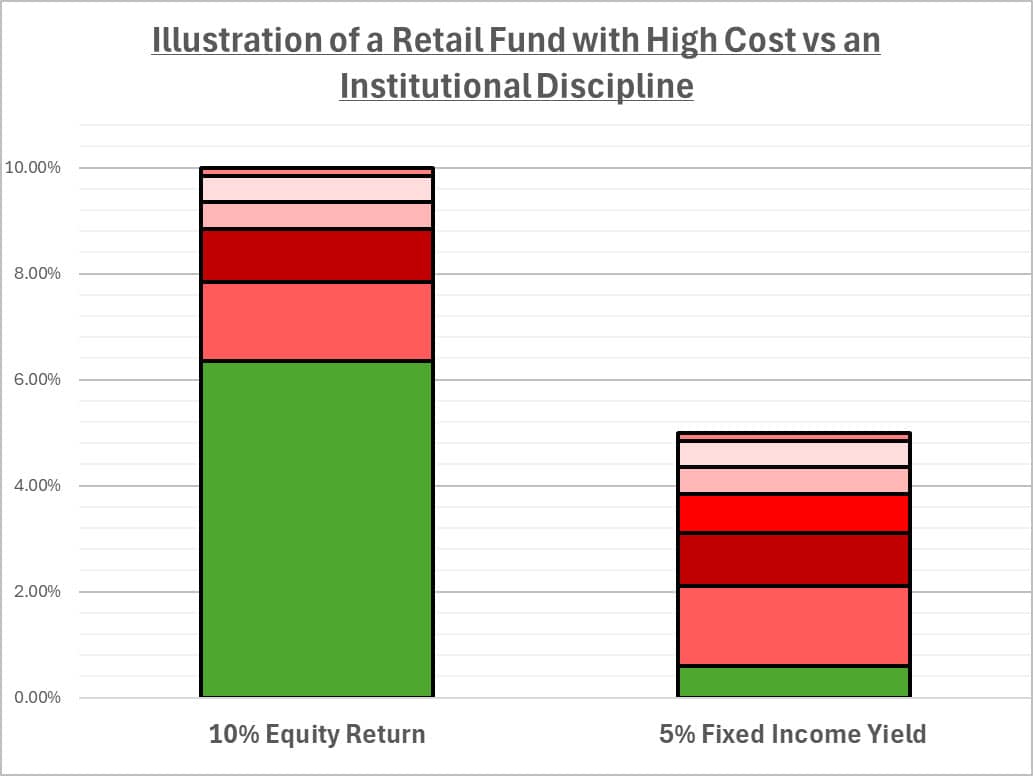
*Fees and cost are hypothetical and not reflective of any specific cost associated with a particular fund.

Enter Institutional Direct Indexing: Your “Private ETF”
Institutional direct indexing offers a solution that overcomes the shortcomings of traditional ETFs. Instead of buying shares in a pooled fund, you directly own the individual securities that make up an index. This approach enables:
- Personalization: You decide which stocks to include or exclude based on your investment goals, risk tolerance, or values.
- Tax Efficiency: Direct ownership allows for tax-loss harvesting at the individual stock level, creating opportunities to offset gains and minimize your tax bill.
- Control Over Capital Gains: You control when and how to realize gains, avoiding the surprise distributions common with pooled funds.
- Screening for Quality: The ability to filter and select investments based on quality criteria.
- Tax-Loss Harvesting: Systematic identification and realization of losses to offset taxable gains.
- Control Over When to Buy/Sell: Flexibility to decide the timing of purchases and sales to optimize outcomes.
In effect, direct indexing allows you to build and manage an index portfolio tailored to your needs–giving you the feel of a “private ETF” without the limitations of pooled structures.
Is Institutional Direct Indexing Right for You?
Institutional direct indexing has traditionally been reserved for high-net-worth investors due to cost and complexity. Firms like Linden Thomas & Co. and Indexperts are making institutional direct more accessible. If you value customization, tax efficiency, and control over your investments, direct indexing may be a superior alternative to traditional ETFs.
While a “private ETF” doesn’t exist, direct indexing provides a powerful way to achieve the same goals with greater flexibility and efficiency. The future of indexing is personal–and direct indexing is leading the way.
Related Articles