



Investors often rely on historical returns to assess the performance of individual stocks, sectors, or entire asset classes. However, focusing on average returns–whether for an individual asset or for an entire portfolio–can lead to misconceptions when those returns experience sudden flips. A “flip” occurs when a particular asset, sector, or class of assets transitions from positive returns to negative returns (or vice versa) over a short period. These fluctuations can have a significant impact on investor behavior, often leading them to chase past performance or abandon sound investment strategies. Understanding how average returns can shift dramatically, and the implications of these changes, is crucial for long-term investment success.
When average returns change unexpectedly, they can mislead investors into making decisions based on recent results. Take, for example, sectors or asset classes that see a large rally in one year–this can significantly skew the average returns for a given period. The recent positive performance can draw in investors, tempting them to concentrate their investments in the outperforming asset. However, as history has shown, once returns flip, the performance can turn negative just as quickly. The most successful investors know that jumping on trends based on short-term returns can lead to missed opportunities or even substantial losses. A diversified portfolio, built with long-term goals in mind, can help mitigate the effects of these sudden flips and provide the stability needed to weather such market changes.
Example 1: Large Cap Growth vs. Small Cap Value (2021 Q1 vs. 2021 Q4)
In the first quarter of 2021, large-cap growth stocks were performing solidly, with a 26.7% return over the past year, while small-cap value stocks were seeing extraordinary growth, with a 71.5% return over the same period. This massive performance disparity led many investors to shift their attention towards small-cap value stocks, assuming that they would continue to outperform. However, by the fourth quarter of 2021, the average performance flipped dramatically. Large-cap growth stocks surged with a 27.0% return, while small-cap value stocks decelerated to just 4.1%. The change in performance was significant enough to flip the perception of each asset class’s relative strength.
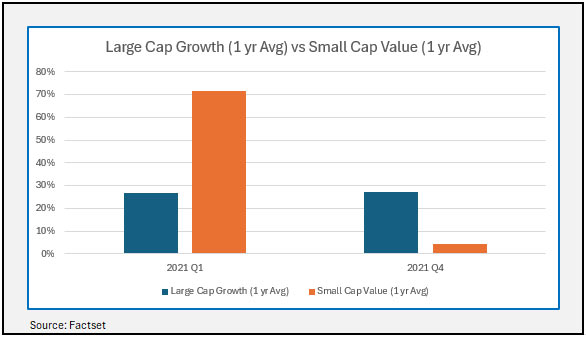
This example shows how easily a sector’s performance can flip in a short time, leaving investors caught off guard. Rather than chasing the next big winner based on one year’s performance, investors who maintained a diversified portfolio could have capitalized on the performance of both large-cap growth and small-cap value stocks over time.
Example 2: Mid Cap Growth vs. Small Cap Value (2016 Q4 vs. 2018 Q2)
In the fourth quarter of 2016, small-cap value stocks were significantly outperforming mid-cap growth stocks, with a 5-year average return of 12.4% compared to 9.3% for mid-cap growth. This performance disparity likely drew many investors to small-cap value stocks, attracted by their higher returns. However, by the second quarter of 2018, the tables had shifted. While small-cap value stocks still posted strong returns, their 5-year average dropped to 10.1%, while mid-cap growth stocks surged to a 5-year average of 11.54%.
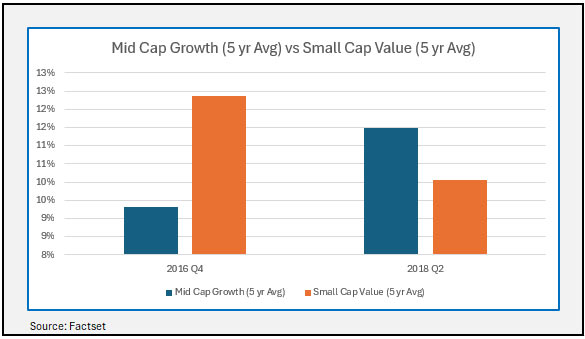
This flip demonstrates how rapidly asset performance can change, as investors who were initially drawn to small-cap value stocks may have missed out on mid-cap growth’s superior returns over the subsequent years.
Example 3: Mid Cap Growth vs. Small Cap Value (2022 Q4 vs. 2023 Q1)
At the end of 2022, both mid-cap growth and small-cap value stocks were struggling, with 1-year average returns of -31.8% and -21.8%, respectively. This downturn likely reflected broader market challenges, leaving investors wary of riskier asset classes. However, just one quarter later, in 2023 Q1, a striking reversal occurred. Small-cap value stocks rebounded to a modest 1-year average return of 5.1%, while mid-cap growth stocks saw an even stronger recovery, climbing to a 1-year average return of 15.2%.
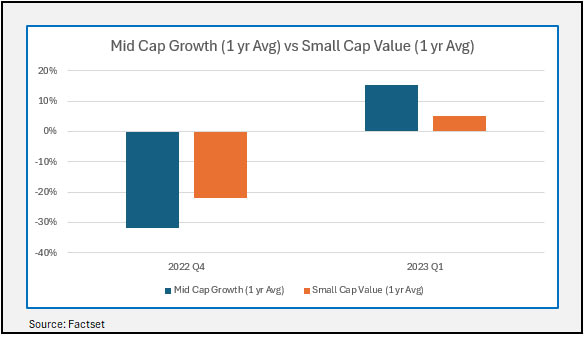
This rapid shift illustrates how quickly market conditions can change, rewarding investors who remained patient through the downturn.
Example 4: Large Cap Growth vs. Small Cap Value (2023 Q2 vs. 2024 Q2)
In 2023 Q2, Small Cap Value stocks outpaced Large Cap Growth, with 3-year average returns of 15.6% compared to 8.8%. This reflects a period where smaller, undervalued companies benefited from favorable market conditions or renewed investor interest. However, by 2024 Q2, the tide had shifted. Small Cap Value stocks faced a downturn, dropping to a 3-year average return of -1.4%, while Large Cap Growth stocks maintained steady performance, improving slightly to 10.9%.
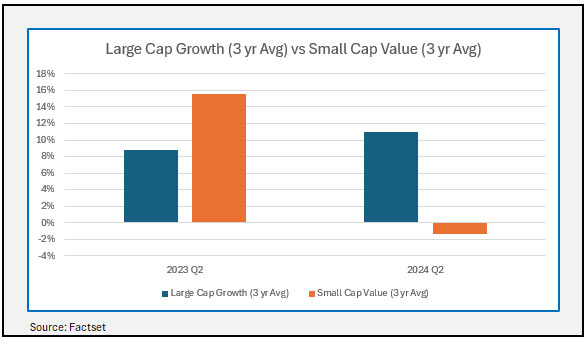
This example highlights the cyclical nature of market leadership and the importance of diversification to weather such shifts.
The Dangers of Chasing Returns
The key lesson from these examples is clear: chasing returns based on recent performance can be a risky proposition. Investors who attempt to jump from one asset class or sector to another based solely on short-term trends risk missing the long-term benefits of a diversified portfolio. While average returns can fluctuate significantly from year to year, a diversified portfolio–one that is designed with a long-term strategy in mind–can better withstand the flips in performance. Trying to time the market or reacting impulsively to recent performance is more likely to lead to poor outcomes than sticking to a disciplined, diversified investment strategy.
Market cycles are a natural part of investing. One year, a particular asset or sector may outperform, and the next, it may underperform. Instead of chasing the hottest asset class based on recent performance, the best course of action is to maintain a diversified portfolio that includes a mix of asset classes and sectors. This approach will ensure that you are exposed to the top-performing assets when they rise and insulated from the worst-performing ones when they dip.
Diversification and Patience: The Winning Strategy
The most successful investors know that spreading risk and patience are crucial to long-term success. By spreading your investments across various sectors, securities, and asset classes, you can better ensure that your portfolio can adapt to the inevitable flips in performance. While it may seem tempting to chase high returns or abandon an underperforming sector, history shows that maintaining a diversified portfolio and staying the course is often the best strategy.
The pie chart below illustrates a sample asset allocation designed to achieve a well-diversified portfolio:
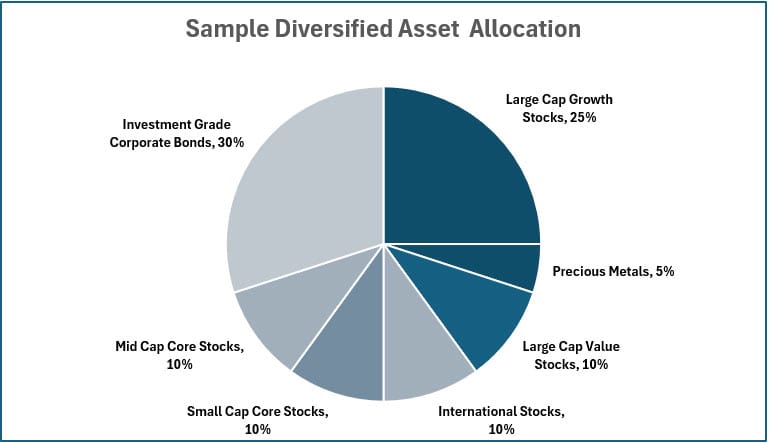
In conclusion, when average returns flip–whether it’s between sectors, asset classes, or individual stocks–it’s important to resist the urge to chase performance. Investors who stay disciplined, focus on quality, and maintain a diversified portfolio will likely see better long-term results.
Related Articles

How Do Recent Returns Impact Average Returns?
Investment Principles,
Top Investment Principles FAQs,
Understanding Results,
November 19, 2024

What are Rallies, Pullbacks, and Average Returns?
Investment Principles,
Top Investment Principles FAQs,
Understanding Results,
November 3, 2023

Waiting for Recovery Instead of Chasing Returns
Investment Principles,
January 8, 2025