

Chasing hyped-up stocks or trendy themes often ends in tears. Why? Because media hype can distort our perception of underlying reality and confuse our ability to distinguish between good and bad stocks. Continual reassurance by Wall Street and the media may build confidence in a given security, but hype tells us nothing about its underlying quality.
The unfortunate reality is that sometimes bad companies get promoted by a combination of Wall Street and media hype and their stock prices surge – albeit temporarily. Unfortunately, the hype surrounding bad companies can last an uncomfortably long time.
And when stock prices run up, there’s often a natural impulse to want to buy hot stocks. It’s a form of social proof, signaling that the market believes the company must be doing something extraordinary – and for the investor, it’s seen as a chance to make money. For many investors, when a hot stock runs, the fear of missing out can feel overwhelming.
Media-hype can fuel stock prices to extraordinary levels, even for more speculative, low-quality, or even struggling companies. Unwary investors can get sucked into the hype-machine, enticed by flattering praise from Wall Street, glorification of these companies in the financial media, and of course, by the elevated stock prices themselves. Some investors make the tragic mistake of buying low-quality stocks during periods of hype, but these stocks can’t manage the transition when the winds of change inevitably blow in. Unfortunately, this sad situation is repeated over and over and sucks in many unsuspecting investors.
In the short term the market is a popularity contest, but in the long term the market is a weighing machine that eventually gets it right.
So, at moments in time, low quality companies can be popular and have stock prices that shoot to the moon. But rising stock prices don’t stop the underlying businesses from being terrible. Eventually, those same low-quality stocks that shot into orbit come crashing back down to Earth. As sure as spring follows winter, the cycles inevitably change – even if we don’t know how long a given season may last. In the final analysis, the market ultimately rewards patience, and not chasing stocks.
To steel your mind against the mirage of media-hype, consider the following list of low-quality companies that the market first lifted to elevated levels, only to leave investors wiped out in the aftermath of their bankruptcy:
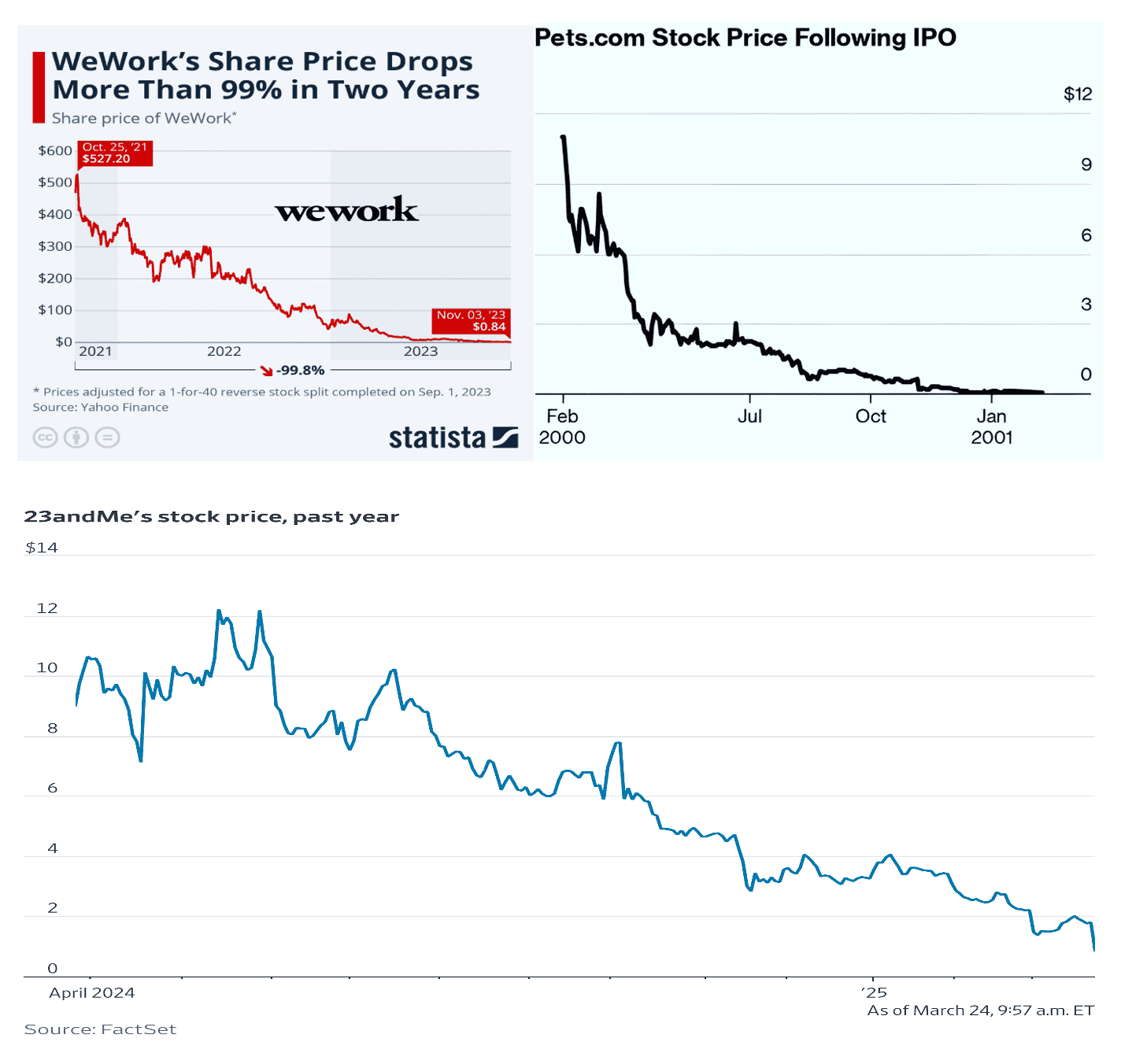
- WeWork (WE) – This company was hyped in the early 2020’s as a revolutionary “future of work” company that would transform office space into a global community platform. During its short life it never turned a profit, losing $2-4 billion each and every year. The stock peaked at $527 in October of 2021 and was bankrupt by November 7, 2023.
- 23andMe Holding Co. (ME) – This company was hyped in the early 2020’s as a revolutionary consumer genetics company that would democratize personal health and ancestry insights with direct-to-consumer DNA kits. The company lost approximately $180 million to $250 million each year, with losses totaling 40-80% of revenues each year. The stock peaked at $12 in 2024 and was delisted in 2025.
- Pets.com (IPET) – Pets.com was hyped in 1999-2000 as the poster child of the dot-com boom, with massive investor excitement around its sock-puppet mascot, Super Bowl ads, and vision of becoming the Amazon of pet supplies, promising to revolutionize pet retail through e-commerce and home delivery. The company lost $61.8 million on revenue of $619,000 in 1999 and lost $147 million on revenue of $4.2 million in 2000. The stock peaked at $11.00 per share 2 days after its IPO on Feb 7, 2000, approximately 10 months before the company collapsed and was delisted.
- Enron Corporation (ENE) – This company experienced enormous hype in the late 1990’s and early 2000’s as a transformative energy company. However, the company was using “creative” financing by hiding debt in special purpose entities and fraudulently reporting earnings. The stock peaked at $90.75 on August 23, 2000 and filed for bankruptcy on December 2, 2001.
- Rite Aid Corporation (RAD) – Rite Aid saw periodic retail hype during opioid litigation resolutions and pharmacy recovery narratives, with investors betting on its turnaround potential in essential healthcare retail. The company lost (-$456.7 million) in 2020, (-$15.9 million) in 2021, (-$91.7 million) in 2022 and (-$1.29 billion) in 2023. The stock peaked at $17 on January 27, 2021 and collapsed to zero by October 15, 2023.
- Silicon Valley Bank (SVB) – This company experienced enormous hype during the pandemic because their clientele was comprised primarily of tech companies, which were booming. However, the company ignored sound principles of banking and took on material, and unnecessary, interest rate risk in their portfolio. The stock peaked at $629.39 on November 8, 2021 and was delisted in March 2023.
- Blockbuster Inc. (BBI) – This company was hyped as an entertainment powerhouse in the early 2000’s. The company reported a net income of $337 million in 2002, net income of $59 million in 2003, a net loss of (-$984 million) in 2004, and ongoing material losses thereafter. The stock peaked at $30 on August 16, 2002 and filed for bankruptcy on September 23, 2010.
- Sears Holding Corporation (SHLDQ) – This company experienced massive hype surrounding its acquisition by famed hedge fund manager Eddie Lampert who shed the company’s real estate assets and merged with Kmart. The stock peaked at $142.51 on April 7, 2007 and was delisted in October of 2018.
- Lehman Brothers (LEH) – Lehman Brothers enjoyed massive hype around its growth in asset backed securities, subprime mortgages and real estate markets in 2006 and 2007. Although their earnings were spiking, it was due to a highly risky gambit of using short term funding to buy [low-quality] long-term assets. The stock peaked at $86.18 on February 1, 2007 and famously declared bankruptcy on September 15, 2008.
As these examples illustrate, continual reassurance by Wall Street and the media may build confidence in a given security, and can distort our perception of underlying reality – confusing our ability to distinguish between good and bad stocks. Remember, hype tells us nothing about its underlying quality. Earnings matter. Sound balance sheets matter. Cash flow matters. In short, quality matters to long run portfolio performance. Chasing hot stocks is a fool’s game that history has proven time and time again to be a sure way to earn substandard returns. Don’t chase the hype. Ever.
Here is a more complete list of publicly traded stocks that were hyped and later delisted due to bankruptcy:
- NKGen Biotech, Inc. (NKGN) stock was hyped with speculative retail and biotech excitement around its activated NK cell therapies for cancer and neurodegenerative diseases, peaked at ~$5-$10 in 2023-2024 and ultimately was delisted on July 2025 (suspended March 2025).
- Aquaron Acquisition Corp. (AQUN) stock was hyped with investor speculation on a merger in the new energy sector (e.g., hydrogen or sustainable tech), peaked at ~$10-$12 in 2023 and ultimately was delisted on July 2025 (suspended March 2025).
- Avenue Therapeutics, Inc. (ATXI) stock was hyped with retail and biotech investor hype around its pipeline in pain management and rare diseases (e.g., AJ201 for spinal muscular atrophy), peaked at ~$5-$10 in 2020s and ultimately was delisted in 2025.
- Lytus Technologies Holdings PTV Ltd. (LYT) stock was hyped on its IPTV streaming, telemedicine, and fintech platform narrative in emerging markets (India), peaked at ~$5-$15 in 2020s and ultimately was delisted in 2025.
- Alpine 4 Holdings, Inc. (ALPP) stock was hyped during the 2021 meme-stock and small-cap frenzy with retail traders touting its “DSF” acquisition roll-up model in niche industrials as a potential multi-bagger turnaround story, peaked at ~$10-$20 in 2021 and ultimately was delisted on April 2025 (suspended late 2024).
- Orgenesis Inc. (ORGS) stock was hyped with strong retail and biotech investor pumps around its decentralized POCare platform for cell/gene therapies, peaked at ~$10-$15 in 2020 and ultimately was delisted on April 2025.
- BIMI International Medical Inc. (BIMI) stock was hyped with retail speculation during the pandemic healthcare surge around its medical supply/hospital partnerships and low-float volatility as a perceived COVID recovery play, peaked at ~$5-$15 in 2020s and ultimately was delisted on January 2025 (suspended 2024).
- Slam Corp. (SLAM) stock was hyped during 2021 SPAC mania with investor excitement on potential high-profile merger targets and warrant arbitrage plays, peaked at ~$10-$12 in 2022 and ultimately was delisted on January 2025.
- Clover Leaf Capital Corp. (CLOE) stock was hyped as a blank-check vehicle with trader enthusiasm for extension news and speculation on a lucrative deal in its target sectors, peaked at ~$10-$12 in 2022 and ultimately was delisted on January 2025.
- The Dixie Group, Inc. (DXYN) stock was hyped with periodic investor interest during housing booms around its brand-name flooring products and perceived recovery in home improvement spending, peaked at ~$10-$15 in 2010s and ultimately was delisted on January 2025.
- Vertex Energy, Inc. (VTNR) stock was hyped during the clean energy transition narrative with investor excitement around its used motor oil recycling and renewable diesel focus as a green energy play, peaked at ~$10-$20 in 2022 and ultimately was delisted on January 2025.
- Signature Bank (SBNY) stock was hyped as a “crypto-friendly” bank serving digital asset firms, with pumps from institutional and retail interest in blockchain exposure during the 2021-2022 crypto bull run, peaked at ~$400 in 2022 and ultimately was delisted on March 13, 2023.
- Party City Holdco Inc. (PRTY) stock was hyped with seasonal pumps around holidays and events, with investor optimism on its dominant position in party goods and perceived resilience in celebration spending, peaked at ~$15-$20 in 2010s and ultimately was delisted in 2023.
- Toys “R” Us Inc. (TOYSQ) stock was hyped in the early 2000s and mid-2010s as a classic retail turnaround story with its category-killer dominance in toys and potential for private-label growth, peaked at ~$30-$40 in 2000 and ultimately declared bankruptcy on September 19, 2017.
- RadioShack Corporation (RSH) stock was hyped in the late 1990s-early 2000s as a consumer electronics leader with strong store network and mobile phone partnerships, peaked at $30.00 on August 16, 2002 and ultimately declared bankruptcy on February 5, 2015.
- Kodak (Eastman Kodak Company) (KODK) stock was hyped for decades as the undisputed king of photography with massive institutional and retail support around its brand strength and early digital imaging efforts, peaked at ~$94 in 1997 and ultimately declared bankruptcy on January 19, 2012.
- Circuit City Stores Inc. (CCTYQ) stock was hyped during the 1990s-early 2000s consumer electronics boom with its big-box format and perceived edge over Best Buy in customer service and selection, peaked at ~$30-$35 in 2000 and ultimately declared bankruptcy on November 10, 2008.
- Washington Mutual Inc. (WaMu) (WM) stock was hyped in the mid-2000s as a high-growth retail banking powerhouse with aggressive mortgage lending and branch expansion, peaked at ~$50-$55 in mid-2003 and ultimately was seized by regulators on September 25, 2008 (delisted September 26, 2008).
- Bear Stearns Companies Inc. (BSC) stock was hyped as a scrappy, high-return Wall Street player with strong fixed-income and hedge-fund expertise, peaked at ~$170 in January 2007 and ultimately was sold to JPMorgan Chase on March 16, 2008 (effectively delisted March 14, 2008).
- General Motors Corporation (GMGMQ) stock was hyped with blue-chip status and periodic revival narratives around SUV/truck dominance and cost-cutting, peaked at ~$80-$90 in 2000 and ultimately declared bankruptcy on June 1, 2009.
- Chrysler Group LLC (DCC) stock was hyped in the late 1990s after the Daimler merger with excitement around synergies and minivan/SUV strength, peaked at ~$50-$60 in 1998 and ultimately declared bankruptcy on April 30, 2009.
- PG&E Corporation (PCG) stock was hyped as a stable dividend-paying utility with steady growth in California’s population boom, peaked at ~$70-$80 in 2017 and ultimately declared bankruptcy on January 29, 2019.
- Adelphia Communications Corporation (ADELQ) stock was hyped during the 1990s cable boom with investor enthusiasm for its rapid subscriber growth and broadband rollout, peaked at ~$60-$70 in late 1990s and ultimately declared bankruptcy on June 25, 2002 (delisted February 13, 2002).
- Kmart Corporation (KMRTQ) stock was hyped in the 1990s as a discount retail leader with pumps around Martha Stewart partnerships and perceived value edge over Walmart, peaked at ~$20-$30 in early 1990s and ultimately declared bankruptcy on January 22, 2002.
- WorldCom (MCI WorldCom) (WCOEQ) stock was hyped during the telecom/internet boom with aggressive acquisition-fueled growth and Bernie Ebbers’ “buy and build” strategy seen as unbeatable, peaked at ~$60 in June 1999 and ultimately declared bankruptcy on July 21, 2002.
- Global Crossing Ltd. (GX) stock was hyped as a revolutionary fiber-optic network builder in the late 1990s internet explosion with excitement around global undersea cables and bandwidth capacity, peaked at ~$60-$70 in 2000 and ultimately declared bankruptcy on January 28, 2002.
- Polaroid Corporation (PRDQ) stock was hyped with enduring brand strength as the instant photography king and investor optimism around digital transition efforts, peaked at ~$60 in 1990s and ultimately declared bankruptcy on October 12, 2001 (delisted 2001).
- Refco Inc. (RFX) stock was hyped during its 2005 IPO as a leading commodities and futures broker with strong growth in emerging markets and hedge-fund clients, peaked at ~$30 in August 2005 and ultimately declared bankruptcy on October 17, 2005.
- IndyMac Bancorp Inc. (IMB) stock was hyped during the housing boom as a high-growth mortgage originator with innovative Alt-A loans and strong earnings, peaked at ~$40-$50 in 2006 and ultimately declared bankruptcy on July 11, 2008.
- MF Global Holdings Ltd. (MF) stock was hyped under Jon Corzine as a bold commodities trading powerhouse with excitement around proprietary trading and emerging markets bets, peaked at ~$10-$15 in 2011 and ultimately declared bankruptcy on October 31, 2011.
- Energy Future Holdings (EFH) stock was hyped at its 2007 leveraged buyout as a massive Texas energy play with stable regulated utilities and deregulation upside, peaked at ~$100 in 2007 (pre-LBO) and ultimately declared bankruptcy on April 29, 2014.
- Thornburg Mortgage Inc. (TMA) stock was hyped as a high-yield mortgage REIT with a “safe” focus on prime jumbo loans, peaked at ~$30-$40 in 2007 and ultimately declared bankruptcy on May 1, 2009.
- Conseco Inc. (CNO) stock was hyped in the late 1990s as a fast-growing insurance and finance roll-up with aggressive acquisition strategy, peaked at ~$30-$40 in 2000 and ultimately declared bankruptcy on December 17, 2002.
- Arthur Andersen LLP stock was hyped with prestige as one of the Big Five accounting firms with global clients and confidence in its audit quality, peaked at N/A (private) in late 1990s and ultimately dissolved on June 15, 2002 (effectively delisted).
- Bethlehem Steel Corporation (BS) stock was hyped with decades of industrial-era prestige as a foundational American steelmaker with periodic pumps around defense contracts, peaked at ~$20-$30 in 1980s and ultimately declared bankruptcy on October 15, 2001 (delisted 2001).
- Pacific Gas & Electric Company (PG&E) (PCG) stock was hyped as a stable dividend-paying utility with steady growth from population and energy demand, peaked at ~$50-$60 in late 1990s and ultimately declared bankruptcy on April 6, 2001.
- Texaco Inc. (TX) stock was hyped as a blue-chip oil giant with strong investor support during 1980s energy cycles, peaked at ~$80-$90 in 1980s and ultimately merged with Chevron on October 9, 2001 (effectively delisted 1987 from earlier issues).
- Financial Corp. of America stock was hyped during the early 1980s S&L deregulation boom as a high-growth thrift with aggressive lending, peaked at ~$20-$30 in 1980s and ultimately was seized and liquidated in September 1988.
- Bank of New England stock was hyped in the late 1980s as a Northeast banking powerhouse with commercial lending growth during the real-estate bubble, peaked at ~$30-$40 in late 1980s and ultimately was seized by regulators on January 6, 1991 (delisted January 1991).
- Tower Records stock was hyped in the 1990s as a cultural music retail icon with global flagship stores and exclusive releases, peaked at ~$20-$30 in the 1990s and ultimately declared bankruptcy on October 2006.
- Linens ‘n Things (LIN) stock was hyped in the early 2000s during the housing boom with investor enthusiasm for its affordable linens and housewares as a resilient home goods play, peaked at ~$30-$40 in 2000s and ultimately declared bankruptcy in 2008.
- Borders Group Inc. (BGP) stock was hyped in the 1990s-early 2000s as a sophisticated lifestyle bookseller with cafes and music superstores, peaked at ~$30-$40 in 2000s and ultimately declared bankruptcy on February 16, 2011.
- American Apparel Inc. (APP) stock was hyped in the mid-2000s as a hip ethical fashion brand with made-in-USA manufacturing and provocative ads, peaked at ~$10-$15 in 2000s and ultimately declared bankruptcy on October 5, 2015.
- Quiksilver Inc. (ZQK) stock was hyped during the 1990s-2000s action-sports boom with excitement around its surf/snow/skate brands and celebrity endorsements, peaked at ~$20-$30 in 2000s and ultimately declared bankruptcy on September 9, 2015.
- Aeropostale Inc. (ARO) stock was hyped in the 2000s-early 2010s as a teen clothing mall leader with affordable trendy apparel, peaked at ~$30-$40 in 2010s and ultimately declared bankruptcy on May 4, 2016.
- Sports Authority Inc. stock was hyped during the 2000s fitness and outdoor sports boom with investor optimism around its big-box format and brand partnerships, peaked at ~$30-$40 in 2000s and ultimately declared bankruptcy on March 2, 2016.
- The Limited stock was hyped in the 1990s as a go-to mall brand for professional women’s apparel with excitement around its Express and Victoria’s Secret spin-offs, peaked at ~$30-$40 in 1990s and ultimately was liquidated in 2017.
- Payless ShoeSource (PSS) stock was hyped during economic downturns as a recession-resistant discount footwear leader with ultra-low prices and family shopping appeal, peaked at ~$20-$30 in 2000s and ultimately declared bankruptcy on April 4, 2017.
- Gymboree Group Inc. stock was hyped in the 2000s-2010s with parent-driven excitement around its cute kids’ apparel and play-and-learn brand tie-ins, peaked at ~$30-$40 in 2010s and ultimately declared bankruptcy on June 12, 2017.
- True Religion Apparel Inc. (TRLG) stock was hyped in the mid-2000s as a premium denim leader with celebrity endorsements and the “luxury jeans” trend, peaked at ~$30-$40 in 2000s and ultimately declared bankruptcy on July 17, 2017.
- BCBG Max Azria Group stock was hyped in the 2000s as an accessible luxury womenswear brand with runway-inspired designs and mall expansion, peaked at ~$20-$30 in 2000s and ultimately declared bankruptcy on March 2017.
- Tuesday Morning Corporation (TUES) stock was hyped with value investors’ excitement around its “treasure hunt” closeout model and deep discounts on name-brand home goods, peaked at ~$20-$30 in 2010s and ultimately declared bankruptcy on December 2020.
- Pier 1 Imports Inc. (PIR) stock was hyped in post-recession home improvement cycles with retail investor enthusiasm for its imported eclectic decor as an affordable refresh option, peaked at ~$20-$30 in 2010s and ultimately declared bankruptcy on February 17, 2020.
- Modell’s Sporting Goods stock was hyped with loyal regional Northeast investor support for its sports merchandise dominance and team gear demand, peaked at ~$20-$30 in 2000s and ultimately declared bankruptcy on March 11, 2020.
- Stein Mart Inc. (SMRT) stock was hyped as a “designer brands at discount” off-price play with investor excitement for its perceived edge in women’s apparel, peaked at ~$15-$20 in 2010s and ultimately declared bankruptcy on August 12, 2020.
- Lord & Taylor stock was hyped with legacy prestige as a historic luxury department store with investor interest in its flagship NYC store, peaked at ~$30-$40 in 2000s and ultimately declared bankruptcy on August 2, 2020.
- Brooks Brothers Group Inc. stock was hyped with enduring brand prestige as an American heritage menswear label with timeless appeal, peaked at ~$20-$30 in 2000s and ultimately declared bankruptcy on July 8, 2020.
- Christopher & Banks Corporation (CBKC) stock was hyped with niche retail support for its affordable women’s clothing and perceived mid-market value, peaked at ~$10-$15 in 2010s and ultimately declared bankruptcy on January 14, 2021.
- Belk Inc. stock was hyped with strong regional Southeast investor loyalty for its family-owned heritage and exclusive brands, peaked at ~$20-$30 in 2000s and ultimately declared bankruptcy on February 2021.
- Guitar Center Inc. stock was hyped with music enthusiast and investor excitement during the 2000s guitar boom around its massive inventory and lesson programs, peaked at ~$20-$30 in 2000s and ultimately declared bankruptcy in 2020.
- Barneys New York Inc. stock was hyped as a high-fashion tastemaker with investor optimism around its exclusive designer partnerships and flagship store allure, peaked at ~$30-$40 in 2000s and ultimately declared bankruptcy on July 14, 2019.
- Diesel USA Inc. stock was hyped in the 2000s as a premium denim and edgy lifestyle brand with retail investor excitement for its provocative marketing, peaked at ~$20-$30 in 2000s and ultimately declared bankruptcy in 2019.
- Charlotte Russe Holdings Inc. stock was hyped during the mid-2000s teen retail boom with investors excited for its trendy low-price apparel and mall expansion, peaked at ~$20-$30 in 2000s and ultimately declared bankruptcy on February 2019.
- Things Remembered Inc. stock was hyped with niche retail support for its engraving and personalization services and holiday gifting demand, peaked at ~$10-$20 in 2000s and ultimately declared bankruptcy in 2019.
- Shopko Stores Operating Co. stock was hyped with regional Midwest investor support as a value-oriented department store and community anchor, peaked at ~$20-$30 in 2000s and ultimately declared bankruptcy on February 11, 2019.
- FullBeauty Brands stock was hyped with niche growth excitement around the expanding plus-size fashion market and online catalog strength, peaked at ~$10-$20 in 2000s and ultimately declared bankruptcy in 2019.
- Sunglass Hut (LUX) stock was hyped in the late 1990s as the dominant specialty eyewear chain with investor excitement around mall-based growth and designer brand exclusives, peaked at ~$20-$30 in 2000 and ultimately was acquired and delisted on 2001.
- Bally Total Fitness Holding Corp. stock was hyped during the early 2000s fitness boom with investor optimism around its nationwide club network and membership growth, peaked at ~$20-$30 in 2000s and ultimately declared bankruptcy on December 10, 2007.
- Harry & David Holdings Inc. stock was hyped with seasonal gift-giving excitement around its premium fruit baskets and holiday catalogs, peaked at ~$20-$30 in 2000s and ultimately declared bankruptcy on March 2, 2011.
- Filene’s Basement stock was hyped with loyal bargain-hunter support in the Northeast for its automatic markdown policy and designer closeouts, peaked at ~$10-$20 in 2000s and ultimately declared bankruptcy on May 2009 (acquired and delisted 2011).
- Syms Corp. (SYMS) stock was hyped as an off-price menswear specialist with investor excitement around its “where the educated consumer shops” slogan, peaked at ~$20-$30 in 2000s and ultimately declared bankruptcy on November 3, 2011.
- Goody’s Family Clothing Inc. stock was hyped with regional Southern retail support for its affordable family apparel, peaked at ~$20-$30 in 2000s and ultimately declared bankruptcy on January 14, 2009.
- Eddie Bauer Holdings Inc. (EBHIQ) stock was hyped with heritage-brand excitement in the 2000s around its outdoor lifestyle positioning and catalog/online growth, peaked at ~$20-$30 in 2000s and ultimately declared bankruptcy on June 17, 2009.
- Wet Seal Inc. (WTSL) stock was hyped in the early 2010s with teen retail enthusiasm for its trendy affordable fashion and mall visibility, peaked at ~$10-$15 in 2010s and ultimately declared bankruptcy on January 6, 2017.
- Coldwater Creek Inc. (CWTR) stock was hyped in the 2000s as a catalog-to-store success story targeting mature women with investor optimism around its comfortable stylish apparel, peaked at ~$20-$30 in 2000s and ultimately declared bankruptcy on April 11, 2014.
- Montgomery Ward & Co. (WARDS) stock was hyped with legacy investor nostalgia as one of America’s original catalog retailers and periodic pumps around its “good value” positioning, peaked at ~$20-$30 in 1990s and ultimately declared bankruptcy on December 28, 2000.
- LTV Corporation (LTV) stock was hyped with periodic industrial revival enthusiasm in the late 1980s-early 1990s around its defense/aerospace contracts and steel assets, peaked at ~$20-$30 in 1980s and ultimately declared bankruptcy on December 29, 2000.
- Fruit of the Loom (FTL) stock was hyped as a staple consumer goods name with steady institutional support for its iconic brand strength and low-cost production, peaked at ~$30-$40 in 1990s and ultimately declared bankruptcy on December 1999.
- Iridium Communications (IRID) stock was hyped as one of the most exciting satellite tech plays of the late 1990s with massive excitement around global mobile coverage from anywhere on Earth, peaked at ~$70 in 1998 and ultimately declared bankruptcy on August 13, 1999.
- Service Merchandise (SRVC) stock was hyped in the 1990s as a value play in the pre-internet shopping era with its catalog/showroom model offering big discounts on jewelry and electronics, peaked at ~$20-$30 in 1990s and ultimately declared bankruptcy on March 1999.
- Boston Chicken (BOST) stock was hyped as a 1990s restaurant darling and high-growth “home meal replacement” concept with strong unit economics, peaked at ~$40 in 1996 and ultimately declared bankruptcy on October 5, 1998.
- Marvel Entertainment Group (MRV) stock was hyped with massive speculative excitement in the early 1990s comic book boom around collectible variants and potential Hollywood adaptations, peaked at ~$30-$40 in 1993 and ultimately declared bankruptcy on December 27, 1996.
- Caldor Inc. (CLDR) stock was hyped with regional Northeast investor support in the early 1990s for its discount department store format and perceived value edge in apparel and home goods, peaked at ~$20-$30 in 1990s and ultimately declared bankruptcy on September 18, 1995.
- Bradlees (BRAD) stock was hyped as a regional discount chain with investor optimism around its apparel focus and competition in the Northeast value retail space, peaked at ~$20-$30 in 1990s and ultimately declared bankruptcy on June 27, 1995.
- Jamesway Corp. (JMWY) stock was hyped with modest regional enthusiasm in the early 1990s as a discount retailer serving rural/suburban markets with its low-overhead model, peaked at ~$10-$20 in 1990s and ultimately declared bankruptcy on July 1995.
- Borden Inc. (BN) stock was hyped as a classic consumer staples name in the 1980s with excitement around its Elsie the Cow brand and diversification into chemicals as a stable dividend payer, peaked at ~$30-$40 in 1980s and ultimately declared bankruptcy on December 22, 1995.
- R.H. Macy & Co. (M) stock was hyped with enduring prestige as America’s department store with investor excitement around its Thanksgiving Parade and NYC flagship, peaked at ~$50-$60 in 1980s and ultimately declared bankruptcy on January 27, 1992.
- Wang Laboratories (WANG) stock was hyped in the 1970s-1980s as the word-processing king with investor enthusiasm for its dedicated systems and office automation dominance, peaked at ~$40-$50 in 1980s and ultimately declared bankruptcy on August 18, 1992.
- Phar-Mor Inc. (PMOR) stock was hyped as a fast-growing “deep discount” drugstore chain in the late 1980s-early 1990s with investor excitement for its low prices and rapid expansion, peaked at ~$20-$30 in 1990s and ultimately declared bankruptcy on August 17, 1992.
- Revco D.S. Inc. (RXO) stock was hyped with regional investor support in the 1980s for its discount pharmacy model as a value play in the growing chain drugstore sector, peaked at ~$20-$30 in 1980s and ultimately declared bankruptcy on July 28, 1992.
- Child World Inc. stock was hyped with toy retail support in the 1980s for its large-format stores and perceived competition in the kids’ toy boom, peaked at ~$10-$20 in 1980s and ultimately declared bankruptcy in 1992.
- Olympia & York U.S.A. stock was hyped in the 1980s as a real-estate powerhouse with iconic properties and global development pipeline, peaked at ~$30-$40 in 1980s and ultimately declared bankruptcy on May 14, 1992.
- Eastern Air Lines (EAL) stock was hyped as one of America’s premier airlines with strong routes and perceived stability in the post-deregulation era, peaked at ~$20-$30 in 1980s and ultimately declared bankruptcy on January 18, 1991.
- Hills Department Stores (HILL) stock was hyped with regional discount retail enthusiasm in the Northeast and Midwest during the 1980s for its no-frills model and low prices, peaked at ~$20-$30 in 1980s and ultimately declared bankruptcy on February 4, 1991.
- Kenner Parker Toys (KPT) stock was hyped in the 1980s toy boom for hits like Star Wars figures, Care Bears, and Nerf with investor excitement around licensing deals and licensed merchandise strength, peaked at ~$20-$30 in 1980s and ultimately was acquired and delisted in 1991.
- Southland Corporation (SLD) stock was hyped as the dominant convenience store play in the 1980s with enthusiasm for its 7-Eleven brand ubiquity and recession-resistant 24/7 model, peaked at ~$30-$40 in 1980s and ultimately declared bankruptcy on October 24, 1990.
- Circle K Corporation (CRK) stock was hyped with aggressive growth excitement in the late 1980s as a fast-expanding convenience chain with Southwest dominance, peaked at ~$20-$30 in 1980s and ultimately declared bankruptcy on May 15, 1990.
- Ames Department Stores (AMES) stock was hyped post-1988 Zayre acquisition as a larger discount retailer with expanded footprint and perceived dominance in the Northeast, peaked at ~$20-$30 in 1980s and ultimately declared bankruptcy on April 1992.
- Federated Department Stores (FDS) stock was hyped in the 1980s as a department store powerhouse (Bloomingdale’s, Macy’s, etc.) with excitement around the Campeau LBO and luxury retail assets, peaked at ~$50-$60 in 1980s and ultimately declared bankruptcy on January 15, 1990.
- Continental Airlines (CAL) stock was hyped after Frank Lorenzo’s takeovers with excitement around cost-cutting, route expansion, and perceived turnaround potential in the deregulated airline industry, peaked at ~$20-$30 in 1980s and ultimately declared bankruptcy on December 3, 1990.
- Integrated Resources Inc. (INTG) stock was hyped in the 1980s junk bond era as a high-yield real-estate and insurance roll-up with enthusiasm for its tax-advantaged limited partnerships, peaked at ~$30-$40 in 1980s and ultimately declared bankruptcy in 1990.
- Carter Hawley Hale Stores (CHH) stock was hyped as a West Coast department store group (The Broadway, Emporium-Capwell) with investor excitement for its regional strength during retail consolidation, peaked at ~$20-$30 in 1980s and ultimately declared bankruptcy on February 11, 1991.
- Drexel Burnham Lambert stock was hyped as the epicenter of 1980s junk bond financing under Michael Milken with massive excitement around high-yield LBOs and market creation, peaked at N/A (private) in 1980s and ultimately filed for bankruptcy on February 13, 1990.
- Campeau Corporation stock was hyped in the late 1980s for its aggressive LBOs of Allied Stores and Federated with excitement around retail synergies and real-estate asset plays, peaked at ~$30-$40 in 1980s and ultimately declared bankruptcy on January 1990.
- Zayre Corporation (ZAYR) stock was hyped in the 1980s as a discount retail leader with excitement for its TJX off-price spin-off success and perceived value in the discount department store segment, peaked at ~$30-$40 in 1980s and ultimately was acquired and delisted in 1990.
- Lincoln Savings and Loan Association stock was hyped in the 1980s deregulation era as a high-growth thrift under Charles Keating with excitement around its real-estate investments and junk bond-backed returns, peaked at ~$20-$30 in 1980s and ultimately was seized and liquidated in 1989.
- Mervyn’s stock was hyped with West Coast retail support in the 1990s-early 2000s for its affordable family apparel and middle-market positioning between discount and upscale stores, peaked at ~$30-$40 in 2000s and ultimately declared bankruptcy on July 29, 2008.
- Orion Pictures Corporation stock was hyped in the 1980s as an independent studio powerhouse with Oscar-winning films and mid-budget hits, peaked at ~$20-$30 in 1980s and ultimately declared bankruptcy on December 11, 1991.
- BCCI (Bank of Credit and Commerce International) stock was hyped globally as a third-world banking giant with Middle East/Asia ties and high returns narrative, peaked at N/A (private) in 1980s and ultimately was seized and liquidated on July 5, 1991.
- Maxwell Communication Corporation stock was hyped in the 1980s as a media empire builder under Robert Maxwell with excitement around acquisitions and global publishing dominance, peaked at ~$20-$30 in 1980s and ultimately declared bankruptcy in 1991.
- Executive Life Insurance Company stock was hyped during the 1980s junk bond era as a high-yield annuity provider with aggressive returns and Michael Milken ties, peaked at ~$30-$40 in 1980s and ultimately was seized and liquidated in 1991.
- Bank of New England (BNE) stock was hyped in the late 1980s as a Northeast banking powerhouse after acquisitions with excitement around commercial lending growth during the real-estate bubble, peaked at ~$30-$40 in late 1980s and ultimately was seized on January 6, 1991.
- Mcorp stock was hyped with Texas banking excitement in the early 1980s around its energy-sector lending and perceived strength in the oil boom, peaked at ~$20-$30 in 1980s and ultimately declared bankruptcy in 1990.
- Gibraltar Savings stock was hyped during S&L deregulation as a high-growth thrift with investor excitement around its real-estate loan portfolio returns, peaked at ~$20-$30 in 1980s and ultimately was seized and liquidated in 1990.
- Imperial Savings stock was hyped in the S&L era for its aggressive lending with investor excitement around high interest rates and real-estate speculation, peaked at ~$20-$30 in 1980s and ultimately was seized and liquidated in 1990.