



There are three aspects of investing that contribute to investor results. First, you must save. Saving over time helps build financial success. Second, spread risk across asset classes. Third, maintain good investment behavior.
Without prudent investment behavior, you can buy the best stocks and bonds in the world and still end up with poor results. Investing means that you’re focusing on a long-term reward. Growth takes time. Good investment behavior often feels unnatural. Prudent investment behavior starts with understanding that tough decisions are often uncomfortable. Two factors that often prevent investors from making wise decisions are fear and greed. Understanding how both these forces can wreak havoc is important.
Back to the basics:
An example: if your portfolio is invested 100% in the S&P 500, and the S&P 500 goes down 25%, then you’ll also go down 25%. Conversely, if you have a portfolio of 50% in S&P 500 and 50% in bonds, and the S&P 500 goes down 25%, you would only be down 12.5%. The inverse is true if the market is up. A more aggressive portfolio like 100% S&P 500 will experience more gains during rallies, but more loss during downturns. Keep in mind you can’t invest directly in the S&P 500, and this is only an example for demonstration. This basic relationship between risk and reward should be at the core of every investor’s behavior. More risk means more potential for growth, but with that potential comes the chance of greater losses.
5 Things Investors Should Avoid
1. Avoid chasing hot dots
Too often investors chase hype. If history has taught investors anything, it’s that chasing results is like betting on a horse after it’s won the race. Many investors made this mistake in the late 1990s when dot-coms showed explosive growth despite scant profits. Investors flocked into these stocks, only to find out that the rally was coming to an end. When the dot-com bubble popped and stocks dropped (in many cases to zero), the hype and euphoria disappeared quickly. The media often only talks about events after the market has already priced it in. For example, at the end of 1999 the 3-, 5- and 7-year average returns of the NASDAQ increased considerably due to a few very good years. This led some investors chasing returns and abandoning more conservative, traditional allocations that might’ve been of higher quality:
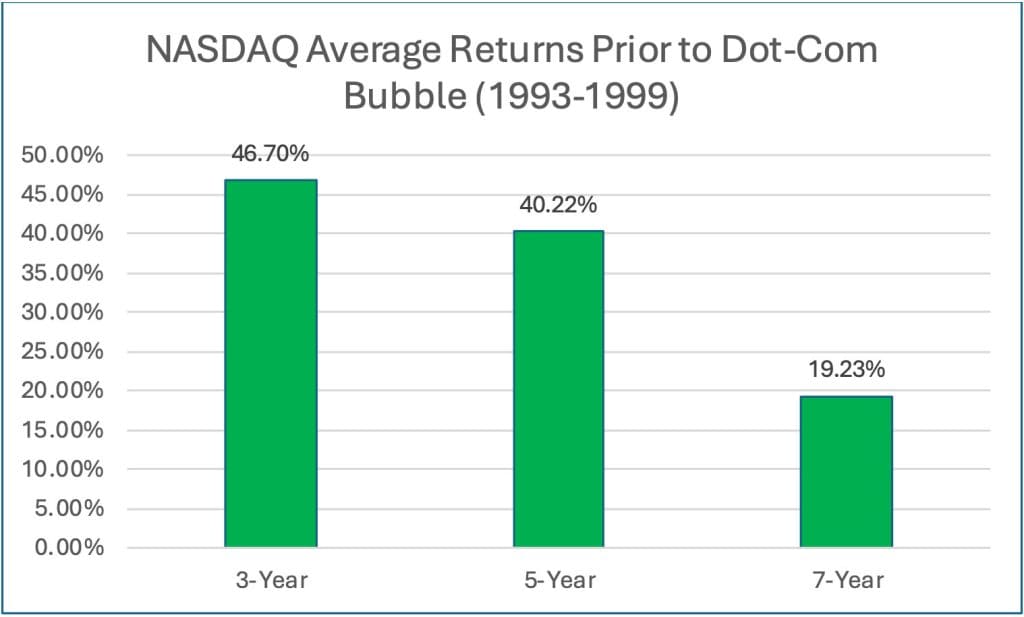 Source: Nasdaq Composite Index.
Things looked very different in 2002:
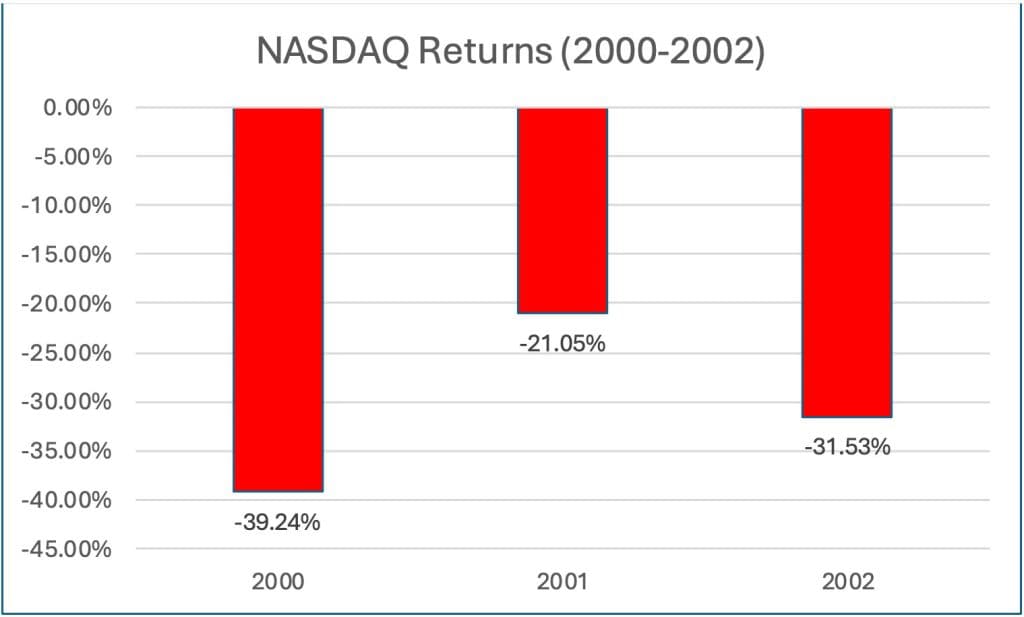 Source: Nasdaq Composite Index.
2. Buy when no one else wants to
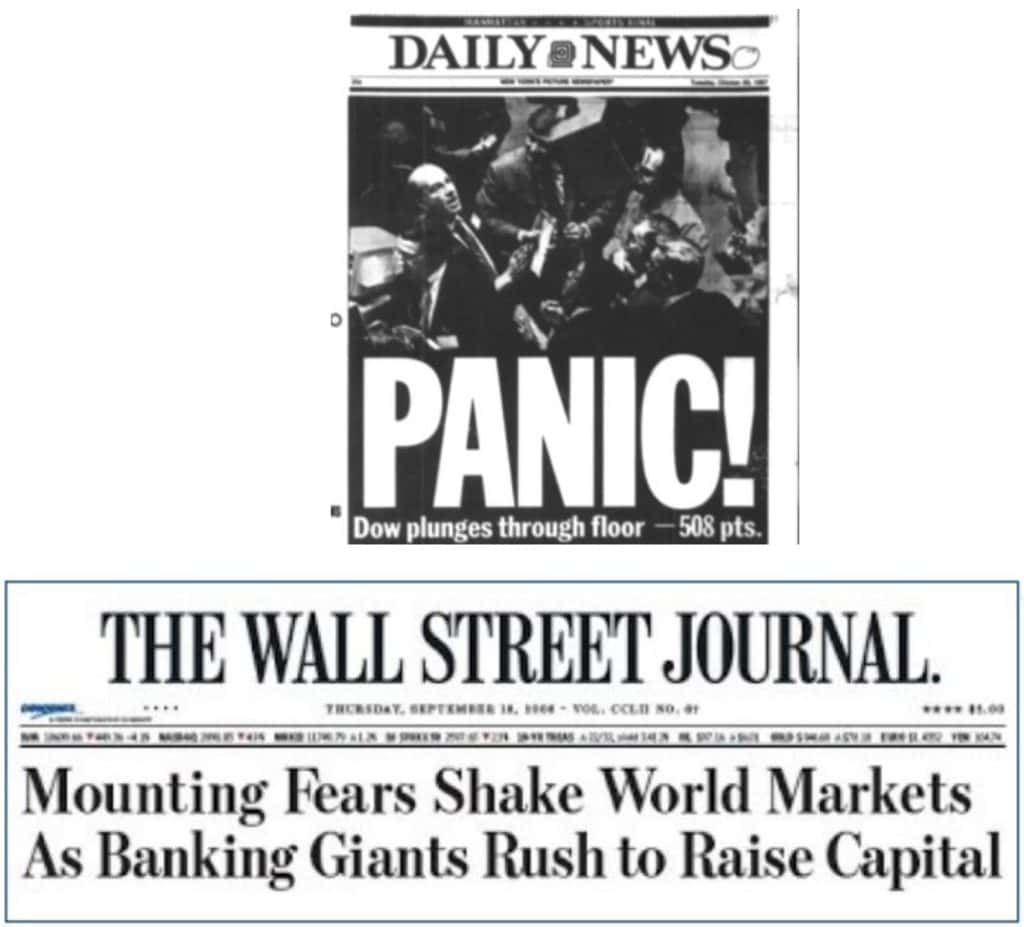
When markets are down, historically the media and many of the Wall Street talking heads tout the negative developments rather than note the opportunities. When things look bad, even when your portfolio is down, adding to your holdings and maintaining your position is essential. Real wealth is built over time by adding to positions when the rest of the world isn’t interested. Down-markets represent opportunities to an investor that is confident in the quality of their holdings. A wise investor once said – “buy when there’s blood in the streets, even if it’s your own blood”. Below are a couple examples of how the media could influence investors to sell in the midst of a downturn, despite quick recoveries being on the horizon:
3. Don’t try to time the market
If you consider the daily movement of stocks and bonds, timing the market is almost impossible. Adding money over time consistently helps build wealth. Spread asset purchases out over long periods to ensure that holdings are accumulated over time. Accumulation of shares, whether in a market ETF or with individual stocks, rewards investors over time.
4. Average returns are not a reflection of future results
When investors seek to invest, they often look over the historical averages on various assets. The challenge for investors is that average annual returns increase or decrease regularly based on the most recent results. For example, if a sector like technology is up 30% in one year, then the 1, 3, and 5-year average returns increase as well. On the other hand, if value stocks were to be down 15%, then it would pull the 1, 3, and 5-year average returns down as well. This relationship between the most recent results and the average results can give investors the wrong impression. Instead of investing based on what will happen in the future, investors buying assets based on average returns may be buying at the peak. The best medicine for this behavior is spreading risk, knowing that you are exposed to the dominant asset class every year, regardless of which asset class it may be.
5. Time is your friend
Historically, the market is made up of bear markets (down-markets), bull markets (rallies), and flat or sideways markets. Over time, markets have proven to reward those who have patience and are willing to be disciplined in all market conditions. Remember, timing the market seldom works, but time in the market often does. Understand that growing wealth requires time and spreading risk. Speculation and chasing the hype seldom pays off.
Related Articles

Trifecta: Three Negative Influences on Investor Behavior
Behavior,
Investment Principles,
January 30, 2025

Investor Behavior
Behavior,
Investment Principles,
November 1, 2023

The Media’s Role in Fueling Market Hysteria: Lessons for the Prudent Investor
Behavior,
History of Markets,
Investment Principles,
Markets,
September 19, 2024