



Investing in the stock market is a journey with peaks and valleys. Every investor, regardless of experience, faces the reality that markets will go down at times. So, a natural question arises: if down markets are a normal part of investing, why would anyone choose to put their money at risk? While market declines can be unsettling, understanding the full picture reveals compelling reasons to stay invested through both the highs and the lows.
Down Markets Are Temporary, Growth Is Long-Term
Historically, markets tend to recover from downturns and go on to achieve new highs. Corrections, bear markets, and recessions are part of the natural economic cycle. No one should ever invest thinking it is an easy walk down-hill. While markets may experience periods of decline, long-term trends show that growth has been the prevailing pattern. For example, the S&P 500 has returned an average annualized return of around 10% over the last century, despite several significant drops. If you zoom out from the day-to-day noise, the stock market has generally rewarded long-term investors who stay the course.
The Power of Compounding
Even if markets fluctuate, the magic of compound growth is a crucial reason to invest. When you invest, the returns you earn can generate their own returns. This effect grows exponentially over time. By staying invested and reinvesting your earnings, your wealth can snowball even in the face of short-term volatility. Those who sell during downturns not only lock in losses but also miss out on the opportunity for their investments to recover and benefit from compounding in the future.
From the early 1900’s to the present, we have seen World Wars, a Great Depression, many recessions, and most recently a global pandemic. Timing these events at their peaks and valleys is almost impossible. This is why we believe that one should always build a portfolio that is well-balanced based on its ability to withstand short-term volatility with a long-term perspective. The important thing is to stay invested, as history has shown the markets bounce back.
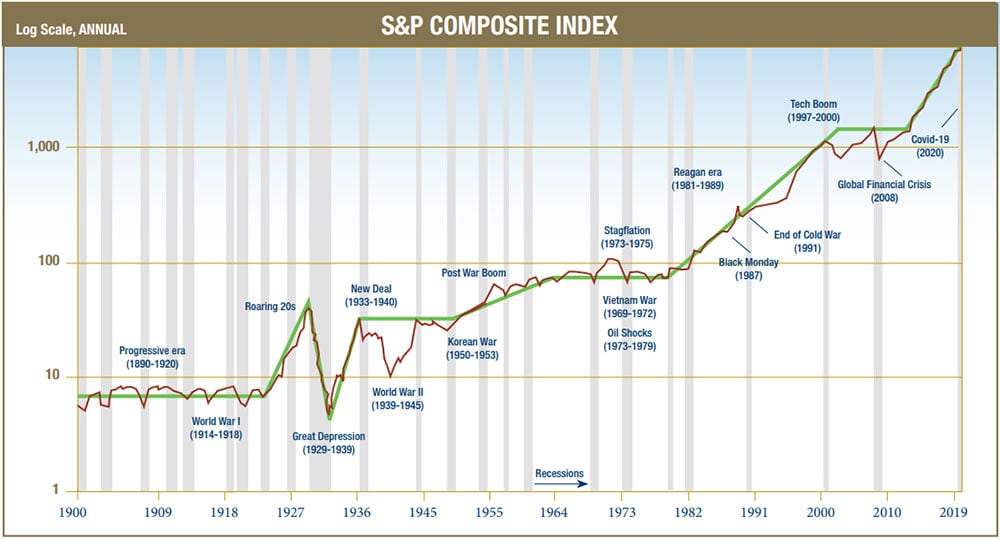
Source: S&P 500
Long recoveries can be frustrating but wise investors see an opportunity to accumulate shares at a discount. Remember: shares are more important than value. The value of a portfolio fluctuates, but the number of shares doesn’t. For those that don’t have investable capital, or don’t have the wisdom to add to their shares, long recoveries can create bad behaviors and poor results.
Market Timing Doesn’t Work
Many investors try to time the market by pulling out when they expect a downturn and re-entering when they believe the worst is over. However, this strategy is notoriously difficult to execute successfully. Missing just a few of the best-performing days in the market can significantly impact your overall returns. Studies show that most of the best days in the market occur during periods of high volatility, often when things feel the most uncertain. By staying invested, you avoid the risk of missing out on the recovery after a down market.
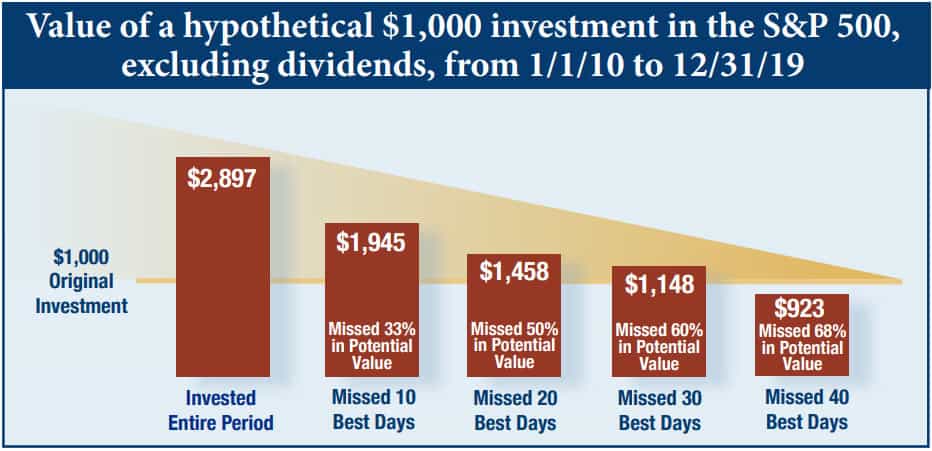
Source: Zephyr
One of the worst things investors can do is pull out after a down-market only wen they believe the worst is over. The challenge is that the markets often prices-in events in advance. All too often the media and industry professionals still have a negative outlook, but the market is already in full recovery mode.
Volatility Creates Opportunity
While down markets can be challenging emotionally, they also present opportunities. During market declines, many stocks and assets are priced lower than their intrinsic value, creating potential buying opportunities for long-term investors. Those who have a disciplined approach and continue to invest during downturns can acquire shares at a discount. When the market rebounds, these investments can yield higher returns. It’s often said that “the time to buy is when there’s blood in the streets”–even if that feels counterintuitive in the moment.
Diversification and Risk Management
While no one can predict market movements with certainty, investors can mitigate risk through diversification. By spreading investments across different asset classes, sectors, and geographies, you reduce your exposure to any one area of the market. Diversification helps cushion the blow of a market downturn in one sector while benefiting from gains in others. Bonds, real estate, and other alternative investments can help balance risk, ensuring that your portfolio is not overly reliant on one type of asset.
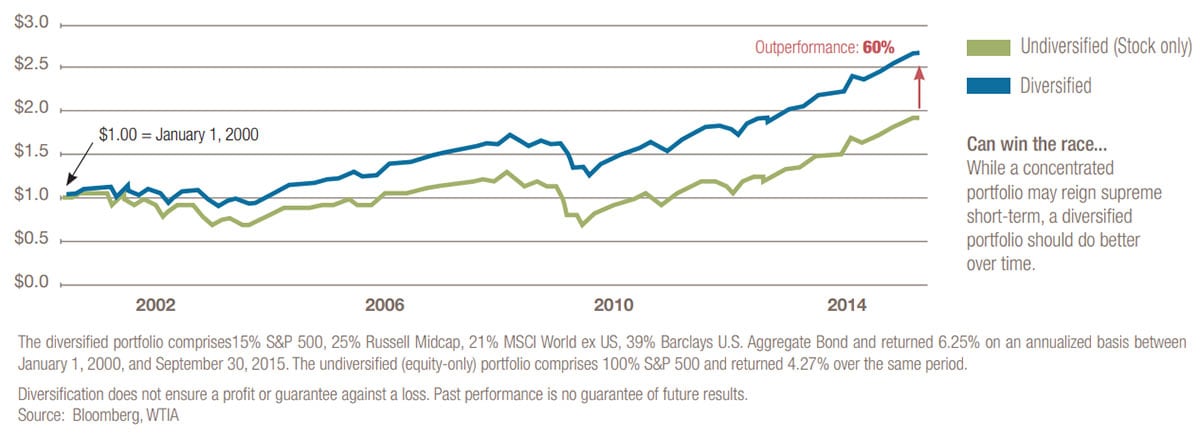
As the illustration below suggests, diversification works by moderating some of the negative returns during down markets, but not eliminating them. Minimizing volatility for a given level of return is important to long-term investment success. To better understand why this is true, you need to appreciate the relationship between volatility and market performance. Volatility tends to decline as the stock market rises and increase as the market falls. As volatility increases, compound returns decrease. The greater the volatility, therefore, the larger the drop in the compound return.
Growth of $1 Invested in Diversified Assets vs. Stock-Only Portfolio
Inflation and Purchasing Power
One of the main reasons to invest is to protect and grow your purchasing power over time. Keeping all your money in cash or low-interest savings accounts might feel safe, but inflation erodes the value of that cash over time. Historically, equities have outpaced inflation and provided better long-term returns compared to cash or bonds. By investing, you give your money a chance to grow faster than inflation, preserving your ability to meet future financial goals.
Emotional Discipline Pays Off
The psychology of investing can be one of the biggest barriers to success. When markets fall, the instinct to sell and avoid further losses can be strong. However, history shows that staying calm and sticking to a disciplined investment strategy often yields better results than acting on fear. Investors who maintain a long-term perspective, regardless of market movements, are more likely to achieve their financial goals. It’s important to focus on your plan, not on short-term fluctuations.
A Long-Term View Wins
Down markets are normal. They are a part of the investment landscape, but they do not define it. Investing is a long-term game, and the key to success is not avoiding downturns but understanding how to navigate them. By staying invested through both the ups and downs, leveraging the power of compounding, and maintaining a diversified portfolio, you give yourself the best chance to build lasting wealth.
With institutional direct indexing, investors can customize their portfolio, allowing for greater control and flexibility. This means that during a market downturn, investors can strategically sell underperforming stocks, harvest tax losses, or adjust exposure to specific sectors that they believe will recover more quickly. Additionally, direct indexing enables investors to tailor their portfolio to align with personal values or financial goals, potentially offering more targeted downside protection than a standard index fund. By evaluating the earnings-quality of the companies in the index, direct indexing investors can add another layer of confidence to their investment strategy.
The question is not why should you invest despite down markets, but why not invest given the potential growth over time? Investing provides an opportunity for your money to work for you, even in the face of uncertainty. By embracing a long-term perspective, you can benefit from the full journey, knowing that down markets are simply a part of the path to greater financial success.
Related Articles

Building a portfolio with a correction in mind vs timing the correction
Investment Principles,
Markets,
Portfolio Considerations,
October 1, 2024

The Market Is Like a Coin—It Has Two Sides: Up and Down
Investment Principles,
Knowledge & Insights,
Markets,
Understanding Results,
September 17, 2024

Why Are Down Markets Your Friend?
Behavior,
Investment Principles,
Markets,
November 19, 2024