



By Indexopedia Research Team | September 17, 2024 | In
When people think about the stock market, they often forget that it’s like a coin with two sides–up and down. On one side, there’s the excitement of gains, the allure of watching your investments grow as the market surges. On the other side, there’s the fear of losses, the anxiety that comes when the market dips. Most investors, however, tend to focus only on one side of the coin, leading them to believe that the market is either a guaranteed path to wealth or a risky game where the odds are always stacked against them. But the truth is that the market is always both, just like a coin, and understanding this duality is key to long-term investing success.
The Up Side: The Market’s Growth Story
The market has a well-documented history of growth over the long term. Despite the inevitable downturns, the overall trajectory of the stock market has been upward. Take, for example, the bull market that followed the Great Recession. On March 9, 2009, the S&P 500 hit a low of 676.53. Many investors were gripped with fear, focusing solely on the downward side of the market. But those who flipped the coin and saw the opportunity on the other side were richly rewarded. By February 19, 2020, the S&P 500 had climbed to 3,386.15, delivering a total return of over 400% from its 2009 lows (see Exhibit 1).
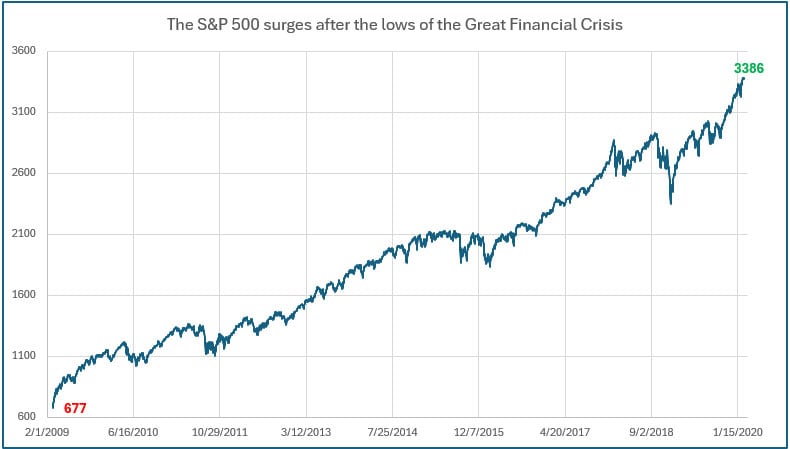
Exhibit 1 (source: Factset)
Yet, even as the market hit this high, many investors wondered if it was wise to invest further. Should they wait for a dip, or should they continue to invest despite the market’s upward climb? This question surfaces time and time again as the market scales new heights. The truth is, the market is designed to reach new highs, and history shows that it does so frequently. In fact, since 1961, the S&P 500 has hit new all-time highs in 39 out of the last 62 years (over 60% of years), proving that reaching new highs is not a rare event but a regular part of the market’s behavior (see Exhibit 2):
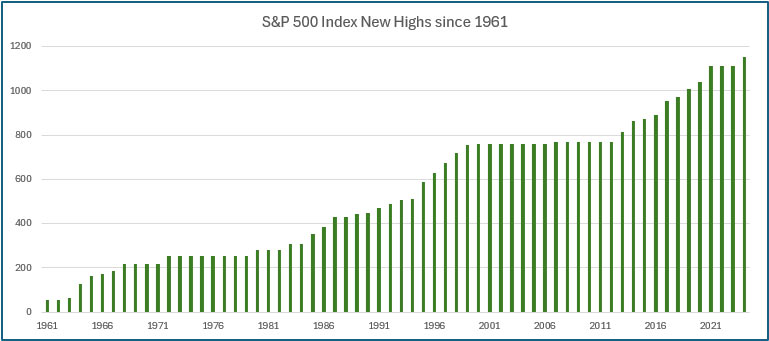
Exhibit 2 (source: Factset)
The Down Side: The Market’s Cyclical Nature
Despite the market’s upward bias, it’s important to recognize that downturns are a natural and inevitable part of investing. Like the tails side of a coin, market declines will happen, and they often come without warning. However, these downturns are not the end of the story–they are part of the cycle that leads to future gains.
Consider the bear market following the Dot-Com bubble bursting in 2000. The S&P 500 lost nearly 50% of its value from its peak in March 2000 to its trough in October 2002. Investors who focused solely on the down side of the coin saw this as proof that the market was too risky. Yet, those who understood that the market has two sides continued to invest. By October 2007, the market had fully recovered and reached new highs, rewarding patient investors with nearly 175% in gains!
The 2020 pandemic-induced market crash offers another example. When the S&P 500 plummeted by 34% in just over a month, many feared the worst. But those who stayed invested saw the market bounce back with unprecedented speed, reaching new highs within six months (see Exhibit 3). The downturn provided a buying opportunity for those who focused on the long-term picture.
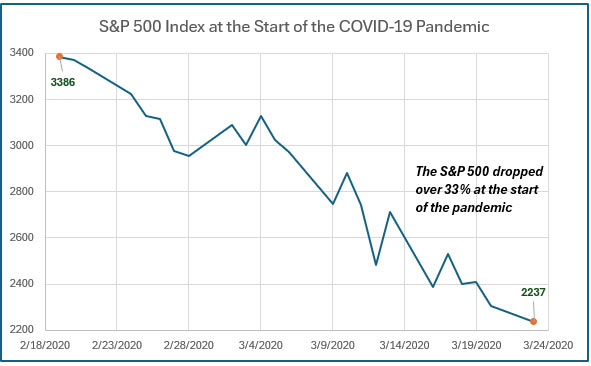
Exhibit 3 (source: Factset)
The Importance of Seeing Both Sides
For long-term investors, it’s crucial to view the market as a coin with two sides. Just as you wouldn’t make a decision based on seeing only heads or tails, you shouldn’t base your investment strategy on the belief that the market will only go up or only go down. Successful investing requires understanding that while downturns can be unsettling, they are often temporary. Historically, the market has always rebounded, and new highs have eventually followed every major low.
Let’s look at four instances when the market hit significant new highs and then continued to rise:
- The Post-War Boom (1949-1966): After World War II, the market surged, hitting new highs throughout the 1950s and 1960s. Despite occasional corrections, the market’s overall trajectory was upward, supported by strong economic growth and corporate earnings, gaining over 500% with 285 new highs!
- The Reagan-Bull Market (1982-1987): Following the severe inflation and recession of the late 1970s and early 1980s, the market began a historic bull run. Even after the crash of 1987, which saw the market lose 22% in a single day, the overall upward trend resumed, leading to 152 new highs in the following years.
- The Tech Boom (1995-2000): Despite the eventual bursting of the Dot-Com bubble, the second half of the 1990s was marked by a remarkable bull market, with the S&P 500 reaching 247 new highs as technology stocks led the charge.
- The Long Bull Market (2009-2020): The recovery from the 2008 financial crisis led to the longest bull market in history, with the S&P 500 hitting numerous new highs and gaining 262%, especially as technology and innovation drove growth.
The table below summarizes the incredible gains experienced by the S&P 500 during the aforementioned time periods (Exhibit 4):
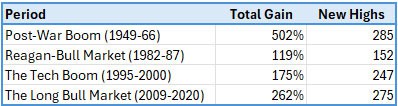
Exhibit 4 (source: Factset)
Why Patience Pays Off in the Stock Market
History shows that over the long run, the stock market has trended upward, although there is no guarantee it will continue to do so. This is why it’s essential to view the market holistically, considering both the ups and downs. Since its inception, the S&P 500 has delivered an average annual return of about 10%, despite countless corrections, bear markets, and economic crises. This consistent upward trajectory makes the stock market one of the most powerful wealth-building tools available.
The truth is that the market’s highs and lows are two sides of the same coin. By understanding and accepting this, investors can avoid the pitfalls of emotional decision-making and stay focused on their long-term financial goals. Those who maintain a balanced perspective, investing in both the good times and the bad, can experience gains over time.
Conclusion: Embrace Both Sides of the Coin
 The market, like a coin, will always have two sides–ups and downs. Successful investors understand that focusing on just one side is a mistake. Recognizing that markets have two sides is important to remember to spread risk and allow time to be your friend. “Time in the market is more important then timing the market” – Stephen L. Thomas, founder Linden Thomas and Company.
While history indicates that markets tend to go up over time, nobody knows for sure when the market will experience a pullback, or a new high. That’s why investors should focus on “time in the market” as opposed to “timing the market” and ensure their portfolio is tailored to their specific risk and income needs.
Related Articles

Rose Colored Glasses: Why Investing During the Good Times Can Create Poor Allocation Tilts
Investment Principles,
Top Investor Mistakes,
March 6, 2025
Why Are Down Markets Your Friend?
Behavior,
Investment Principles,
Markets,
November 19, 2024

Building a portfolio with a correction in mind vs timing the correction
Investment Principles,
Markets,
Portfolio Considerations,
October 1, 2024