



Market pullbacks can be daunting, often testing the nerves of even the most seasoned investors. However, history reveals that these downturns are not only natural but can also present valuable opportunities for those who remain disciplined and focused on long-term goals. Understanding the mechanics of market recovery, the advantages of direct ownership in bond portfolios, and the benefits of a resilient investment strategy can transform the way you view market fluctuations.
The Resilience of Markets
Despite occasional turmoil, markets have consistently demonstrated resilience, rebounding from various economic setbacks. Historical data indicates that pullbacks–temporary declines in stock prices–are typically followed by stabilization and recovery, fueled by factors such as economic growth, corporate profitability, and investor confidence. This resilience is evident in the S&P 500’s performance; over the last 36 years, there have been intra-year pullbacks of 5% or greater in 34 years. Remarkably, during 18 of those years, pullbacks exceeded 10%, and six years experienced declines of 20% or more.
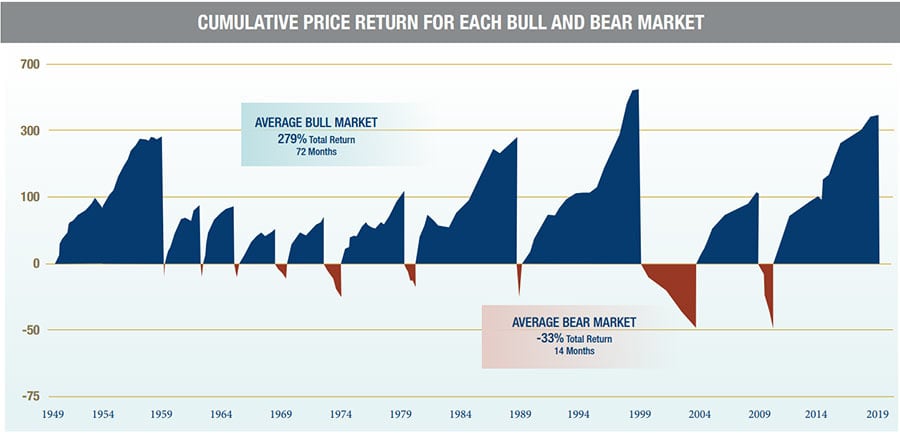
There are four types of investment periods: growth, pullbacks, recovery, and stagnation. The typical investor will experience all four of these periods many times over the course of their life. In fact, if you consider an investing cycle starting in one’s early 20s all the way through to their 90s, the impact of these cycles becomes unavoidable. When looking at the bigger picture, investors should realize that bull markets are stronger than bear markets over the long-term:
Exhibit 1:
Source: S&P 500. It is not possible to invest directly in an index. Indexes are unmanaged and do not reflect the deduction of fees or expenses. All investments are subject to risks, including the risk of loss. Past performance is not indicative of future results.
As surmised from the above, bull markets are historically much longer in duration, but brief bear markets are often where investors make common mistakes. As we saw in the 2008 banking crisis, many investors capitulated and pulled out of the market, thereby missing big parts of the recovery. Those with a quality portfolio would likely have been better off staying the course through recovery, or even adding to their weak positions.
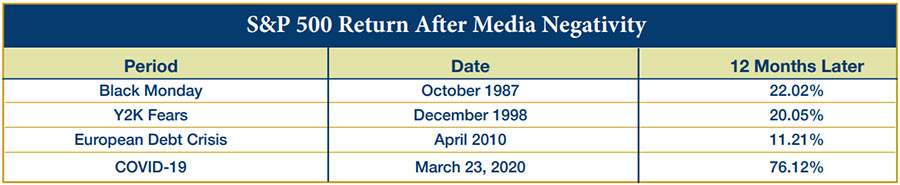
Bad things do happen, but often the recovery is faster and stronger than anyone might expect in the moment. A few examples of sharp market declines followed by strong recoveries can be seen below:
Exhibit 2:
Source: S&P 500. It is not possible to invest directly in an index. Indexes are unmanaged and do not reflect the deduction of fees or expenses. All investments are subject to risks, including the risk of loss. Past performance is not indicative of future results.
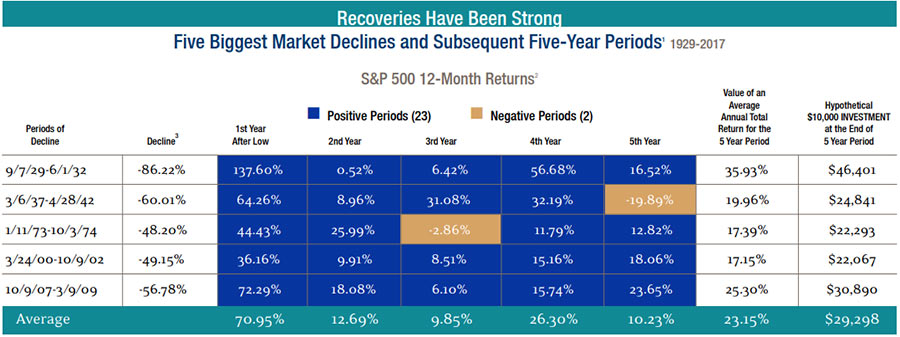
As seen below, from the great crash to the end of the banking crisis of 2009, markets can and will experience pullbacks. However, by staying invested over the five-year period following each bear market, the average results look much different:
Exhibit 3:
Source: S&P 500. It is not possible to invest directly in an index. Indexes are unmanaged and do not reflect the deduction of fees or expenses. All investments are subject to risks, including the risk of loss. Past performance is not indicative of future results.
For example, during the 1929 great crash (which resulted in the Great Depression) the market was down 86.22%. Only five years later, the market’s average annual return was 35.93%. In fact, the first 12 months after each down-market are clearly not something investors want to miss out on. Markets tend to over-sell in bear markets.
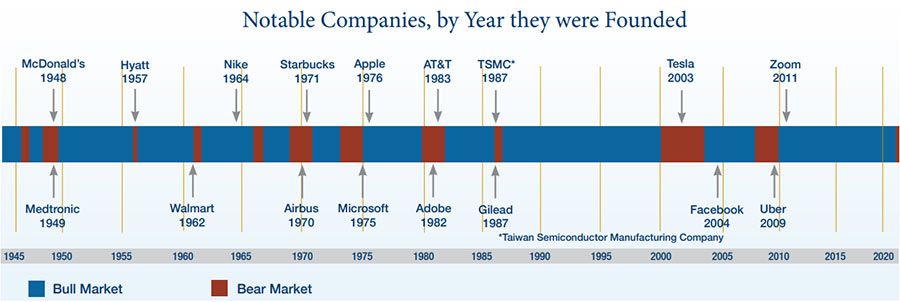
“Bad” markets also make way for new ideas. Companies like Woolworths, RadioShack, K-Mart, and MCI WorldCom don’t exist anymore. Companies that go under often have failed to adapt to changes in technology and consumer needs. However, these pullbacks often open the door for newer, more innovative companies:
Exhibit 4:
As the legendary investor Warren Buffett famously stated, “Be fearful when others are greedy, and greedy when others are fearful”. These words remind us that down markets can serve as an optimal buying opportunity. The key is to embrace these moments rather than succumb to panic.
Behavioral Pitfalls: Resisting the Urge to Jump Ship
One of the greatest challenges investors face is the temptation to chase short-term trends. The accessibility of real-time portfolio data and the incessant chatter from media outlets can shift focus from long-term wealth building to immediate performance tracking. This change in mindset can lead to abandoning sound investments for fleeting trends–often at a loss.
Many investors abandon solid companies in favor of hyped products, such as cryptocurrencies or trendy stocks, only to regret these decisions later. The media often exploits fear and greed, driving investors toward poor choices that yield suboptimal results. A disciplined approach prioritizing direct ownership of equities and fixed income can provide clarity and help foster long-term success.
It is easy to think the grass is greener on the other side when your portfolio is not doing well, but abandoning a long-term strategy due to short-term volatility will only damage results further. While adjustments can and should be made over time, jumping into and out of asset classes or sectors on a whim can be detrimental.
Capitalizing on Down Markets
Investing during downturns can significantly enhance your portfolio’s long-term growth. By recognizing that pullbacks are a normal aspect of market cycles, investors can use these periods to accumulate quality assets at discounted prices. Down markets provide opportunities to buy stocks and bonds with favorable yields, enhancing overall portfolio performance.
Historical evidence supports this strategy. For instance, had you invested $1,000 in the S&P 500 in 1962, your investment would have grown to $78,275 by 2023, demonstrating the power of remaining invested over time. You can see below that the market rewarded patience:
Exhibit 5:
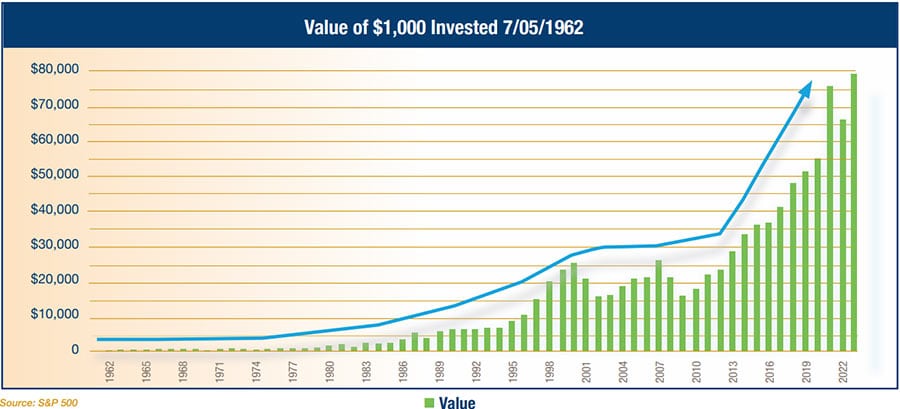
It is not possible to invest directly in an index. Indexes are unmanaged and do not reflect the deduction of fees or expenses. All investments are subject to risks, including the risk of loss. Past performance is not indicative of future results.
Moreover, the ability to add shares during market dips can yield substantial benefits. Buying more shares when prices are low means greater potential for gains when the market recovers. Remember, wealth is accumulated by adding shares. When stocks or bonds are down, the door is open to add to your investments at deeper discounts, increasing your buying power. Too often we love the market when things are going well and hate the market when our account value is down. The real test for investors is during the dips. Adding shares during the dips is hard, but is even more difficult when the media, so-called experts, and friends, are talking about how things are going to keep getting worse. One great saying is, “when there’s blood in the streets, you need to buy. Even if it’s your own blood!”. The truly wise investor buys during the dips and holds on during the rallies, with a focus on long-term results, not short-term greed or pain.
Trying to time the market is a fool’s errand. Even the best informed and most experienced traders can’t predict the future with complete accuracy. When trying to time the market, emotions often make investors wait until they see evidence of a recovery before buying back in. This can be catastrophic to the investor’s portfolio. The chart below shows that missing a few days of growth can devastate returns:
Exhibit 6:
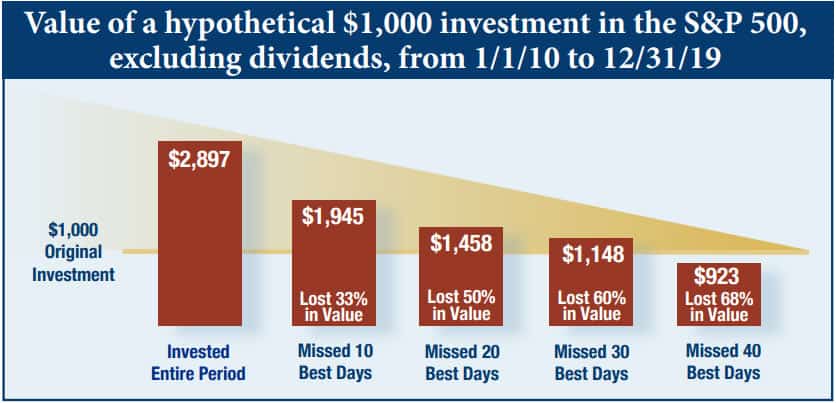
Source: S&P 500. It is not possible to invest directly in an index. Indexes are unmanaged and do not reflect the deduction of fees or expenses. All investments are subject to risks, including the risk of loss. Past performance is not indicative of future results.
In conclusion, down markets are not to be feared; they are your friends. By maintaining a long-term perspective, embracing the benefits of direct ownership, and resisting the urge to chase short-term trends, you can position yourself for success. History has shown that markets recover, and those who remain disciplined through volatility can enjoy the fruits of their patience. As we navigate the inevitable ups and downs of the market, the focus should be on building resilient portfolios that thrive in all conditions.
Related Articles
How Down Markets Can Actually Benefit Investments in Bonds and Dividend Stocks
Behavior,
Fixed Income,
Investment Principles,
Markets,
Why to Buy & Where,
August 14, 2024
How do Index Funds Perform During Down Markets?
Index Investing,
Top Index FAQs,
January 8, 2025

If Down-Markets are Normal, Why Should I Invest?
Markets,
Top Markets FAQs,
January 8, 2025