
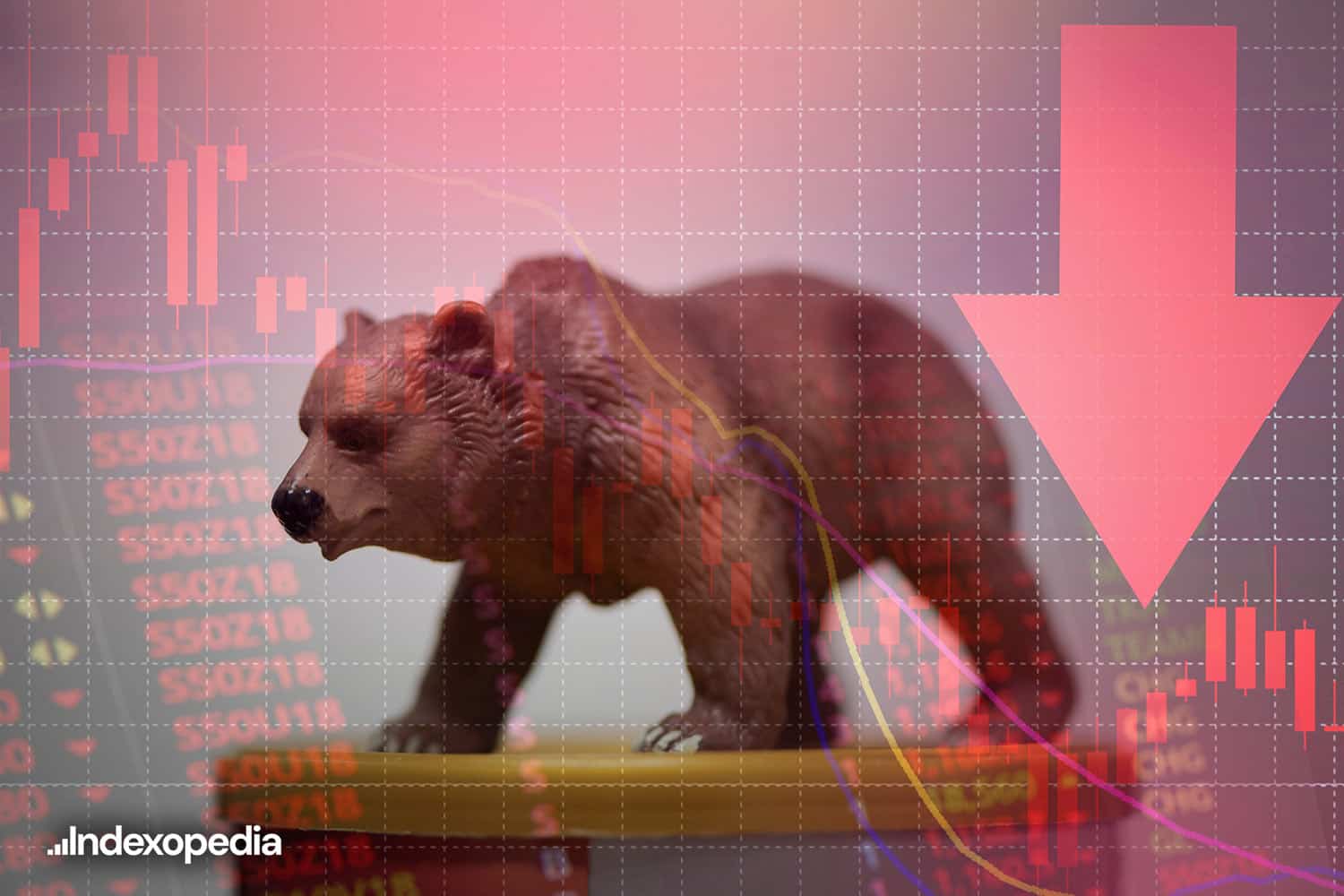


Bears are scary. Bear markets may be even scarier. But just like facing a bear in the wild, knowing what you’re up against and following a well-crafted plan can have a drastic impact on the outcome. Although a bear market is often intimidating, you can navigate through it successfully with the right understanding and strategies.
What Is a Bear Market?
Generally, a bear market is a period in which stock prices fall by 20% or more from recent highs, using one of the major indices as a benchmark (e.g., S&P 500, Dow Jones Industrial Average). Conversely, a bear market ends once a new bull market begins. That is, when the market’s closing price is 20% higher than its bear market low.
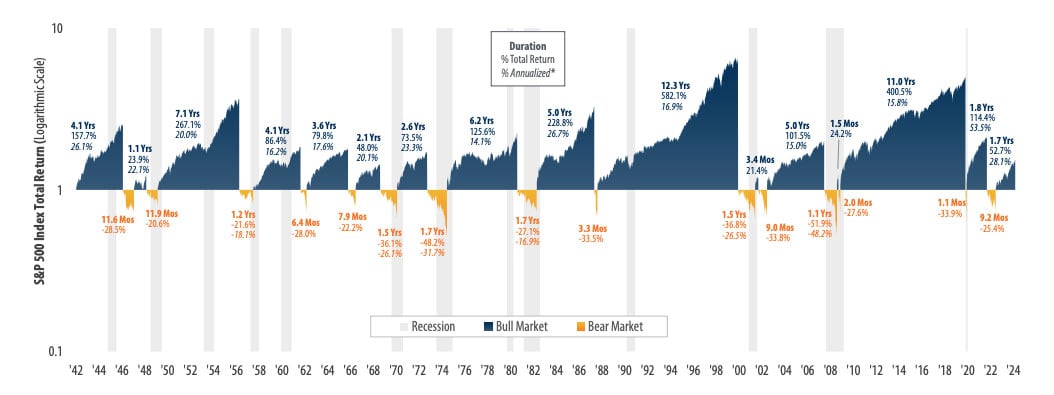
Bear markets are somewhat open-ended concepts that could unfold over weeks, months, or even years. For example, a bear market commenced in August 1987, hit its bottom that December (a 33.5% loss), and wouldn’t end until March 1988. This stretch included the infamous Black Monday on October 19, when the market fell almost 23% in a single trading day, which still stands as the largest one-day market loss on record.
A bear market doesn’t necessarily coincide with a recession. Still, severe stock market declines are often associated with a weakening economy, potentially involving a high unemployment rate, flagging productivity, and negative consumer sentiment.
A Brief History of Bear Markets
No two bear markets are the same, but they are normal occurrences.
Since 1929, there have been 27 bear markets, each of varying length and intensity. However, 12 of those bears took place between 1929 and 1945. Focusing on the last seven decades since 1945, there’s a bear market approximately every five years. Still, averages can be misleading in a historical context; for instance, there were four bear markets in the 2000s, zero bear markets in the 2010s, and, so far, two bear markets this decade.
On average, bear markets last almost 10 months and feature declines around 35%. That said, it’s important to distinguish between duration and recovery. Bear markets technically end when bull markets begin, which is once the market rises 20% from a recent low. On the other hand, the market may not recover to its previous highs for months or even years.
For example, the 2022 bear market began in early January, reached its nadir in October (a 25.4% decline), and ended in June 2023 once the market recovered 20% from its October low. But the S&P 500 wouldn’t eclipse its previous high until January 2024 — two years later.
Date | S&P 500 Closing Price | Change From Peak % | Change From Bottom % | Description |
January 3, 2022 | 4,796.56 | N/A | N/A | Previous high |
October 12, 2022 | 3,577.03 | (25.4%) | N/A | Bear market bottom |
June 8, 2023 | 4,293.93 | (10.5%) | 20% | Bull market is actualized |
January 19, 2024 | 4,839.81 | 0.9% | 35.3% | Recovery from bear market |
Being Strategic During Bear Markets
Stay calm and stick to the plan
Reining in emotions is imperative during a bear market, because impulsive, fear-based decisions rarely produce positive results. On the contrary, panic selling can lock in losses and derail your long-term financial goals.
Keep in mind that downturns are a natural part of the investment cycle. They are inevitable — many bear markets have reared their ugly heads and there will almost certainly be more. And while the past cannot predict the future, it should be reassuring to know the market has recovered every time.
Stay aligned with your long-term investment plan, which should have been designed to weather market fluctuations. By sticking to your plan, you can better situate yourself for the market’s eventual recovery.
 Take advantage of reduced prices
The philosophy of “buy low, sell high” is conceptually easy but difficult in practice. That’s because the noise and pessimism surrounding a bear market can cloud judgment and prevent investors from seeing the forest for the trees.
In many cases, strong companies are pulled down in the fray, possibly well below their intrinsic values. This can create prime entry points for quality investments.
To take advantage of these opportunities, you can employ a common strategy known as dollar-cost averaging — making fixed investments in the market, funds, or select stocks regardless of the economic environment. Historically, markets have recovered from downturns, often leading to substantial gains for those who invested during the lows.
Lean on your advisor
Investing is inherently personal and, therefore, emotional. That’s why the true value of an advisor becomes evident during market extremes: helping clients keep emotions in check whether there’s widespread panic or greedy euphoria.
By consulting and collaborating with your advisor, you can make informed decisions and potentially capitalize on opportunities that arise during bear markets.
Bear Market FAQs
How do I know if we’re in a bear market?
A bear market traditionally occurs when a broader index, such as the S&P 500, declines by 20% or more relative to recent highs. Until the index recovers 20% from its low and actualizes a bull market, the market will remain a “bear.”
Is a bear market the same as a recession?
Although they can happen simultaneously, a bear market and recession are distinct events. A bear market refers to a significant drop in stock prices, while a recession is a prolonged period of economic decline.
The National Bureau of Economic Research (NBER) defines a recession as a significant decline in economic activity that lasts more than a few months and spans the entire economy. That said, the unofficial (and more practical) definition of a recession is two consecutive quarters of negative growth in a country’s real gross domestic product (GDP).
Is a bear market the same as a correction?
Bear markets and corrections both involve falling market prices, but a correction is typically shorter and less severe — specifically, a decline of at least 10% (but less than 20%).
How long do bear markets last?
Historically, the typical bear market lasts about 10 months, but the actual duration can vary significantly. For instance, the pandemic-induced bear market in 2020 lasted 33 days, while the 2008 and 2009 bear markets during the Great Recession lasted a combined 470 days.
Related Articles
Why Are Down Markets Your Friend?
Behavior,
Investment Principles,
Markets,
November 19, 2024

The Market Is Like a Coin—It Has Two Sides: Up and Down
Investment Principles,
Knowledge & Insights,
Markets,
Understanding Results,
September 17, 2024
If Down-Markets are Normal, Why Should I Invest?
Markets,
Top Markets FAQs,
January 8, 2025