



By Indexopedia Research Team | August 14, 2024 | In
Investors often dread market downturns, viewing them as periods of financial loss and instability. However, down markets can present unique opportunities, particularly for those invested in individual bonds and dividend-paying stocks. Unlike mutual funds or ETFs, which often face forced liquidations and suffer from liquidity mismatches, individual securities provide greater control and flexibility. This article explores why down markets might actually be beneficial for investing in bonds and dividend stocks, emphasizing the advantages of direct ownership.
The Advantage of Income Components in Down Markets
1. Bonds: Yield Increases as Prices Fall
When bond prices fall during a market downturn, many investors view this as a negative development. However, for those holding bonds or looking to invest, this can be a significant advantage. As bond prices drop, their yields (interest payments as a percentage of bond price) rise. This means that new investors can purchase bonds at a discount, locking in higher yields for the life of the bond.
Moreover, the income from the bond’s coupon remains unchanged even as its market value decreases. This allows investors to reinvest the steady income at lower prices, effectively buying more bonds and increasing their future income potential.
In the hypothetical example below (Exhibit 1), as the price of the bond falls, the yield increases. This is because the interest received (as a coupon payment) remains constant, even as asset prices are falling.
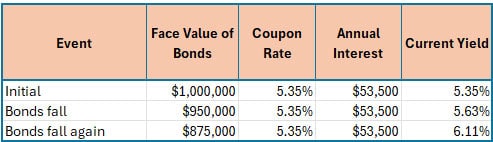
Exhibit 1
Example: During the 2008 financial crisis, U.S. Treasury yields spiked as bond prices dropped, providing attractive entry points for new investors. Those who bought bonds during this period locked in higher yields compared to those who purchased bonds in more stable markets, benefiting from both increased income and potential capital appreciation as the market recovered.
2. Bond Funds and ETFs: The Downside of Forced Liquidations
While individual bondholders can hold their bonds to maturity and continue receiving their regular coupon payments, bond funds and ETFs face a different reality during market downturns. When investors in these funds panic and redeem their shares, fund managers are often forced to sell bonds to meet these redemptions. This can lead to the sale of higher-quality bonds at depressed prices, further exacerbating losses and leaving the fund with a portfolio of lower-quality assets.
Example: In March 2020, during the initial COVID-19 market panic, many bond funds experienced massive redemptions. Fund managers had to sell bonds in a highly illiquid market, driving prices down even further. Investors in these funds suffered significant losses, while those holding individual bonds were able to avoid these forced sales and the associated losses.
3. Dividend Stocks: The Power of Reinvested Income
Dividend-paying stocks offer a dual benefit: the potential for price appreciation and a steady income stream. During market downturns, the income component of dividend stocks becomes even more valuable. As stock prices fall, dividend yields increase, providing investors with a higher income relative to their investment. This steady income can then be reinvested to purchase additional shares at lower prices, enhancing the long-term value of the investment.
In the hypothetical example below, the company continues to pay its stated dividend even as the price of the stock decreases. This not only increases the annual dividend yield but, due to the lower price of the stock, allows the investor to accumulate more shares for the same dollar amount. When prices eventually recover, the investor will have the added advantage of owning more shares and, therefore, enjoy stronger results.
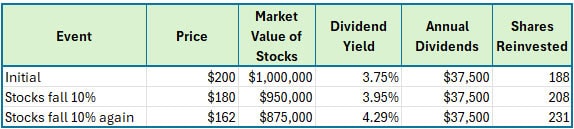
Exhibit 2
Example: During the 2008 financial crisis, high-quality dividend-paying stocks like Johnson & Johnson (JNJ) and Procter & Gamble (PG) saw significant price declines. However, these companies continued to pay dividends, allowing investors to reinvest their income at lower prices. This strategy, known as dollar-cost averaging, enabled investors to accumulate more shares and benefit from the eventual market recovery.
The Deeper the Sell-Off, the Greater the Benefit for Bondholders
One of the key advantages of bonds during market downturns is that their income component does not change. Even as bond prices fall, the coupon payments remain fixed, providing a reliable income stream. This is particularly beneficial in a deep market sell-off, where bondholders can use their income to purchase more bonds at discounted prices, increasing their future income potential.
Example: Consider an investor holding a $1,000 bond with a 5% coupon. If the bond’s price drops to $900 due to market conditions, the investor’s income remains $50 per year. However, with the bond now trading at a discount, the investor can purchase additional bonds with the income, potentially increasing their yield and overall return as the market recovers.
Bonds vs. Dividend Stocks: The Maturity Advantage
While both bonds and dividend stocks offer income, bonds have a unique advantage: they have a maturity date. This means that, regardless of market fluctuations, bonds will eventually be paid back in full at maturity, assuming the issuer does not default. This feature provides a level of security that dividend stocks do not, as stock prices can remain depressed for extended periods.
Example: During the 2008 crisis, many corporate bonds experienced significant price declines. However, investors who held these bonds to maturity received their full principal back, along with the regular interest payments, despite the temporary price fluctuations. In contrast, investors in dividend stocks faced ongoing price volatility without the guarantee of recovering their initial investment.
Down Markets as a Wealth-Building Opportunity
Down markets can be a good thing for accumulating assets, particularly if bonds and dividend stocks are held directly rather than through a pooled fund. Direct ownership allows investors to take advantage of lower prices and higher yields without the risk of forced liquidations or liquidity mismatches that plague mutual funds and ETFs.
By reinvesting income from bonds and dividends, investors can accumulate more shares or bonds at discounted prices, setting the stage for significant gains when the market recovers. This strategy is particularly effective for long-term investors who can weather short-term volatility in pursuit of greater wealth over time.
Example: An investor receiving $1,000 in dividends during a market downturn can reinvest this amount to buy more shares at a lower price. Over time, as the market recovers, these additional shares will contribute to a larger income stream and potential capital gains, illustrating the power of dollar-cost averaging.
Conclusion
Direct ownership of dividend stocks and bonds offers significant advantages, particularly during market downturns. The income generated by these investments can be reinvested at lower prices, leveraging dollar-cost averaging to enhance long-term returns. Moreover, individual ownership provides greater control, flexibility, and potential tax benefits, all while avoiding the forced liquidations and liquidity mismatches that can plague mutual funds and ETFs. By focusing on the income component and maintaining control over their investments, investors can better navigate market volatility and achieve more stable, long-term financial outcomes.
Related Articles

Why Are Down Markets Your Friend?
Behavior,
Investment Principles,
Markets,
November 19, 2024

What Happens to Bonds in Down Markets? Should I Hold or Continue to Buy?
Fixed Income,
Top Fixed Income FAQs,
November 19, 2024

How do Index Funds Perform During Down Markets?
Index Investing,
Top Index FAQs,
January 8, 2025