



By Indexopedia Research Team | September 19, 2024 | In
The stock market just reached an all-time high–again. If you’re like many investors, you might be wondering if now is really the right time to put more money into the market. After all, isn’t buying at a high just asking to get burned? It’s a common concern, but the reality is that hitting new highs doesn’t necessarily mean that the market is on the brink of a downturn. In fact, history shows that new highs are a regular occurrence and can actually be a sign of a healthy, growing market. Let’s dive into why investing after a new high might still be one of the smartest financial decisions you can make.
New Highs Are Normal
First, let’s address the misconception that new highs are rare or a warning sign. The truth is, the stock market hits new highs all the time. Since 1961, the S&P 500 has reached a new all-time high more than 1,100 times as of July, 2024. That averages out to about 20 new highs per year! If you’re holding back from investing just because the market has recently hit a high, you might be missing out on significant opportunities.
While there are many years where the market does NOT reach a new high, in most years the market does hit at least one new high. In fact, since 1961, the market has reached at least one new high 39 times, or 61% of the time.
The chart below (Exhibit 1) illustrates the cumulative number of new highs reached by the S&P 500 since 1961.
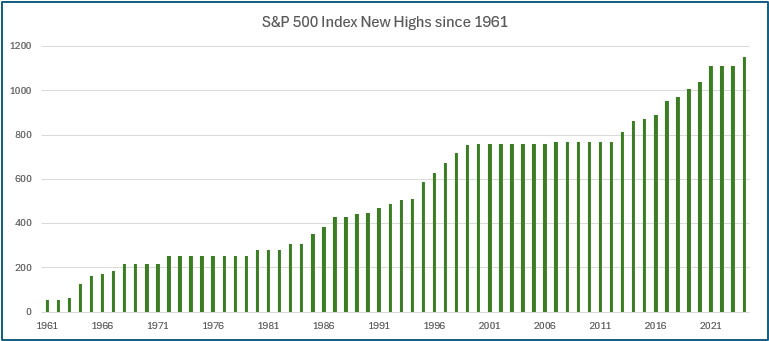
Exhibit 1 (source: Factset)
In fact, over the 12 year period from 2013 to 2024 (July), the stock market made new highs in 11 of those 12 years! Any investor who chose to cash out of equities once the market hit a new high would have missed out on a significant opportunity (see Exhibit 2):
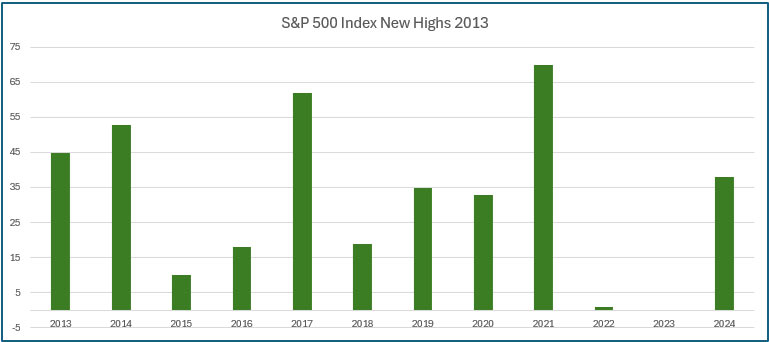
Exhibit 2 (source: Factset)
The Power of Compound Growth
When considering whether to invest after a market high, it’s essential to think about the power of compounding over time. The longer your money is invested, the more time it has to grow. Even if the market does experience a dip shortly after you invest, history suggests, but does not guarantee, that over the long term, the market will recover and continue to grow. The S&P 500, for example, has delivered an average annual return of about 10% over the long term, despite numerous downturns and corrections.
Take a look at this: if you had invested $1,000,000 in the S&P 500 in January 2000, right before the dot-com bubble burst, you might have seen your investment cut in half by 2002. But if you stayed invested and let compounding do its work, by the end of July 2024, your investment would have grown to over $3,758,000, despite the 2008 financial crisis and other market turbulence (see Exhibit 3).
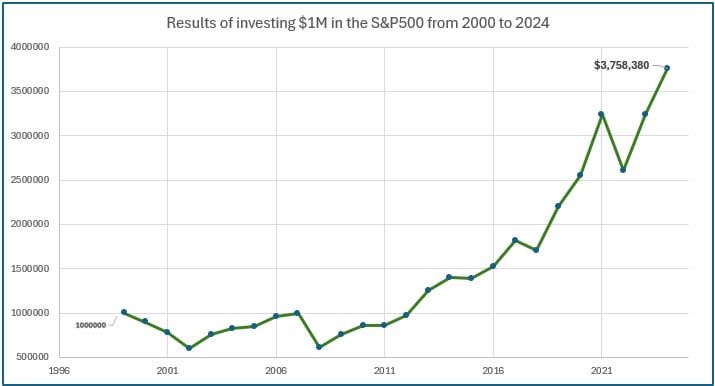
Exhibit 3 (source: Factset)
Dollar-Cost Averaging: A Strategy for Any Market Condition
One strategy that can alleviate the fear of investing at a market high is dollar-cost averaging (DCA). With DCA, you invest a fixed amount of money at regular intervals, regardless of market conditions. This means that you’ll buy more shares when prices are low and reap the rewards should markets move higher. Over time, this strategy can reduce the average cost per share and mitigate the impact of market volatility.
For example, if you invest $10,000 per month into one of the Linden Thomas Indexes, you might buy more shares during a market dip. Over the long term, this can smooth out the highs and lows, allowing you to benefit from the market’s overall upward trajectory.
The Market’s Long-Term Uptrend
Another crucial point to consider is that historically the stock market has tended to move higher over time. Yes, there are periods of volatility, corrections, and even bear markets, but these are typically followed by recoveries that push the market to new heights. The reason is simple: over the long term, the stock market reflects the growth of the economy and corporate profits. As businesses innovate, expand, and increase their earnings, their stock prices tend to rise, driving the overall market higher.
Consider this: the S&P 500 was around 1,500 points in 2007, right before the financial crisis. After the crash, it dropped to about 700 points in early 2009–a 53% decline. But by the end of 2019, the S&P 500 had soared past 3,200 points, more than quadrupling from its 2009 low!
So, if you had hesitated to invest after the market reached a high in 2007, you might have missed out on the tremendous gains that followed the downturn.
Avoiding the Pitfalls of Market Timing
One of the biggest mistakes investors can make is trying to time the market–waiting for the “perfect” moment to invest. The problem is, no one can consistently predict when the market will hit a high or a low. If you’re waiting on the sidelines, you might miss out on gains.
Research shows that missing just a few of the market’s best days can significantly impact your long-term returns. For instance, if you had invested $1,000,000 in the S&P 500 at the beginning of 2000 and stayed fully invested through July of 2024, your investment would have grown to about $3,758,000. But if you had missed just the 10 best days during that period, your investment would only have grown to around $2,043,000. In other words, missing the market’s best days would have meant missing out on over $1.7 million in returns!
The chart below (Exhibit 4) illustrates the impact of missing the best days of the market. Using the prior example, you can see that missing the 10 best days reduces the growth of your $1M investment from $3.76M to $2.04M. Likewise, missing the best 20 days would have reduced your investment from $3.76M to $1.49M. This chart clearly demonstrates how difficult, and dangerous, it is to attempt to time the market.
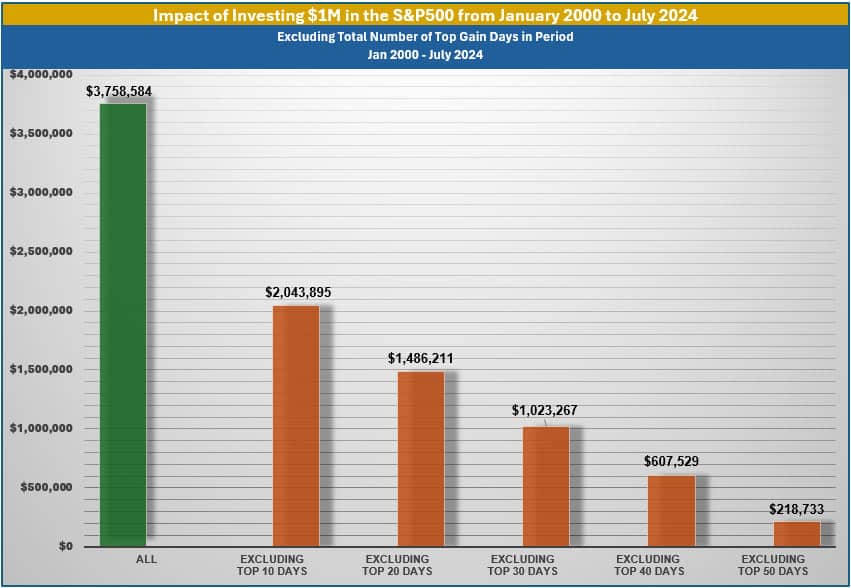
Exhibit 4 (source: Factset)
The Big Takeaway: Invest with Confidence
The stock market hitting an all-time high might give you pause, but history shows that it’s not a reason to shy away from investing. New highs are a normal part of a healthy, growing market, and investing after a high doesn’t mean you’re destined for losses. By focusing on the long term, leveraging strategies like dollar-cost averaging, and avoiding the temptation to time the market, you can confidently invest even when the market is at its peak.
Remember, the market’s upward trend over time has rewarded patient investors. So instead of worrying about whether you’re investing at the top, focus on spreading risk based on your own goals and objectives, adding over time with a long-term perspective keeping in mind that the market is like a coin – it has two sides: down and up. Staying invested over time allows the compounding to take place. By understanding the market’s behavior and maintaining a disciplined investment approach, you can continue to build wealth, even in the face of new all-time highs.
The Bottom Line
While history tells us that markets tend to go up over time, nobody knows for sure when the market will experience a pullback, or a new high. That’s why investors should focus on “time in the market” as opposed to “timing the market” and ensure their portfolio is tailored to their specific risk and income needs.
Related Articles

What is a Bull Market?
Economic Indicators,
Economics,
November 1, 2023

The Market Is Like a Coin—It Has Two Sides: Up and Down
Investment Principles,
Knowledge & Insights,
Markets,
Understanding Results,
September 17, 2024

How does a 1000 Point Drop Compare with History?
History of Markets,
Investment Principles,
Markets,
Understanding Results,
October 21, 2024