


Every few years, a particular asset captures investors’ imagination. Lately, that asset has been gold. Over the past two years, its performance has been strong — more than doubling in price. Naturally, headlines are glowing, pundits are confident, and cocktail conversations are filled with “should I buy gold?” questions.
This is nothing new. Every few years there’s a new “must-own” investment — the one everyone suddenly believes can’t lose. The trouble is, by the time the crowd notices, much of the opportunity has usually passed and the risks are elevated.
Why the Rush?
Gold’s recent run is impressive. From October 2023 to October 2024, it climbed nearly 40%. Then, it tacked on another 49% the following year. In total, it’s been a remarkable two-year stretch. With those kinds of numbers, it’s easy to see why interest has spiked. Online searches for “investing in gold” have tripled over the last year.
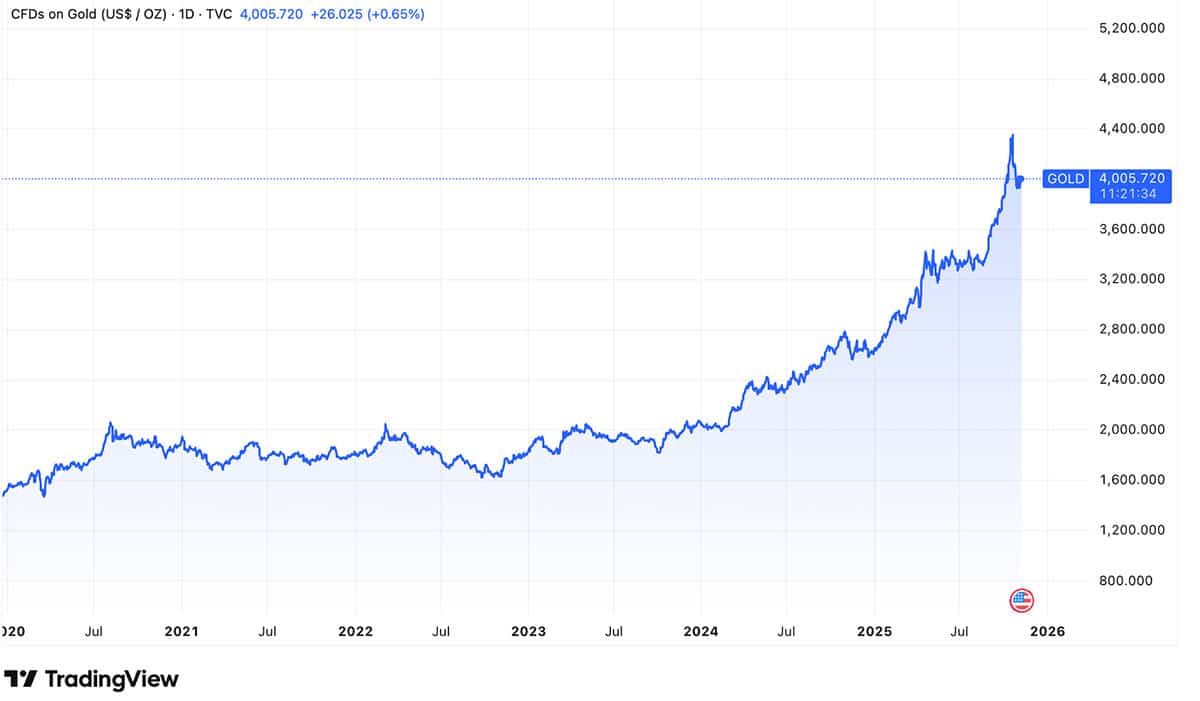
But this pattern of enthusiasm follows a familiar rhythm: prices rise, attention grows, new buyers rush in, and the story feeds on itself. Investors often describe this as “momentum”, but momentum can quickly become herding — the tendency to follow the crowd when uncertainty is high.
In markets, herding often feels rational in the moment. We look around, see other seemingly successful people doing something, and assume they must know more than we do. In truth, they’re usually doing the same thing — reacting to what they’ve just seen.
Gold’s Strengths—and Its Weak Spots
Gold has real virtues. It tends to perform well during periods of financial stress or inflationary concern. When confidence in paper assets weakens, gold’s appeal as a tangible store of value shines. During the 2008 financial crisis, for example, gold rose while equities fell sharply. Across the 20 worst quarters for stocks since 1968, gold outperformed in 19 of them.
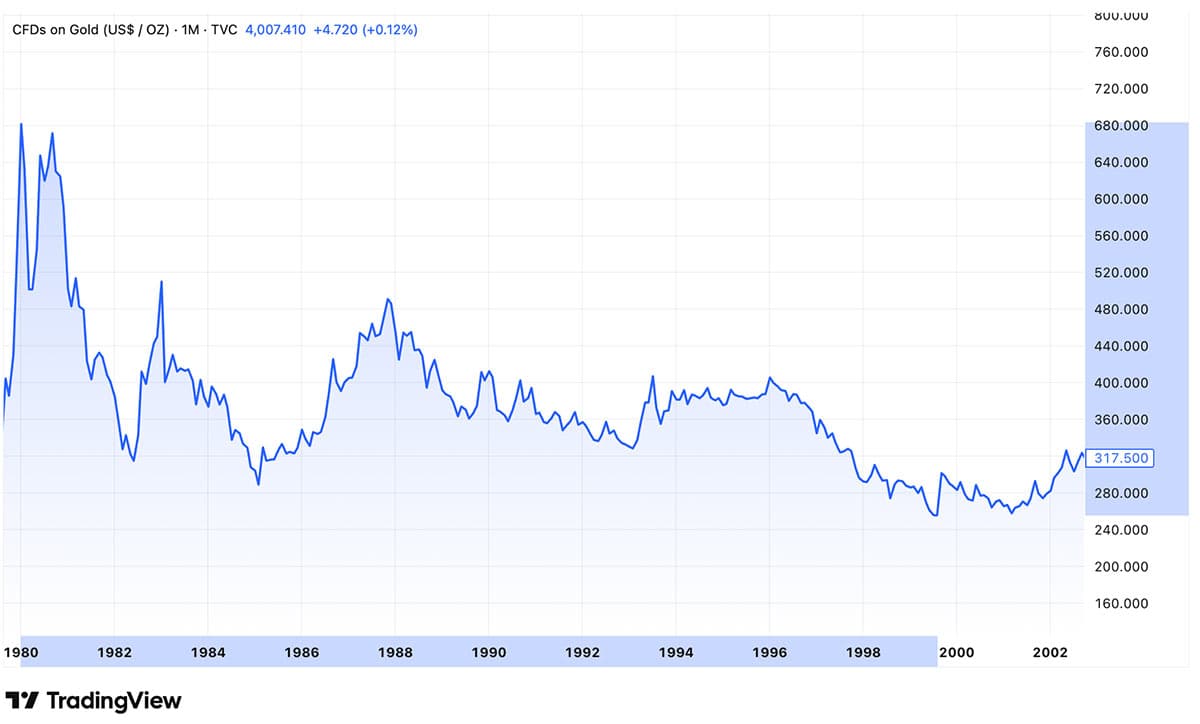
However, gold’s history also reminds us that it’s far from immune to long declines. After soaring from $34 to $680 between 1970 and 1980, many investors were overcome with recency bias—the belief that the “trend won’t end”. But for those who abandoned discipline, a long and difficult road awaited them.
The chart below shows January 1980 to August 1999, nearly a two-decade long bear market for gold where price declined from around $680 to $250, a drop of over 60%.
The pattern is clear: gold delivers its best performance when fear runs high and real interest rates are low. When real rates rise or the dollar strengthens, gold often struggles. That’s because gold doesn’t pay interest or dividends — it simply sits. When cash and bonds begin to offer meaningful yields again, the opportunity cost of holding assets with no yield or cashflow becomes hard to ignore.
The Human Element
Despite this, investors continue to chase gold whenever it rallies. Why? Because in the absence of certainty, we anchor to what feels recent and familiar. When prices rise, it confirms our desire to act. And the more people talk about it, the more credible it feels.
But markets have a way of humbling enthusiasm. Herding behavior can drive prices well above their fundamental value — and then the same emotional current that fueled the buying becomes the selling pressure on the way down.
History shows that investors can lose money in good assets if they abandon their discipline in favor of bad investing behaviors.
A Better Way to Think About It
That’s not to say investors should never own gold. It can serve a valuable function in spreading risk within a well-balanced portfolio — a hedge against extreme scenarios or currency risk. The problem is not the asset itself; it’s the behavior surrounding it.
Too often, investors buy gold not as a part of a plan but as a reaction to headlines. It’s the same pattern we’ve seen with tech stocks in 2000, real estate in 2006, cryptocurrencies in 2021, and possibly “AI plays” today. The story changes, but the human impulse stays the same.
Disciplined investing means resisting that impulse. It means buying based on an investment thesis, not a price chart. It means spreading risk intelligently so no single theme — no matter how shiny — dictates your outcome.
Markets will always tempt investors with narratives. “This time is different” are probably the four most expensive words in investing. The truth is generally simpler: all cycles eventually turn, and the best investors are the ones who are prepared for both.
The Real Treasure
Gold may glitter, but true wealth is built through discipline — staying invested, spreading risk, and letting time do the heavy lifting. Every portfolio will have its moments of doubt and its temptations to chase what’s hot. But those who succeed over decades aren’t the ones who chased the last rally; they’re the ones who stayed the course when everyone else was chasing it.
When enthusiasm reaches a fever pitch, remember: if everyone around you is talking about an asset, it’s probably not a bargain anymore.
Gold will have its moments — and perhaps this is one of them. But no moment, however golden, replaces the power of a sound plan and steady hand. The real prize in investing isn’t what shines the brightest today — it’s what endures tomorrow.
Related Articles
What Are Commodities?
Index Investing,
Index Sectors,
Investment Principles,
November 2, 2023

Trifecta: Three Negative Influences on Investor Behavior
Behavior,
Investment Principles,
January 30, 2025

How Can I Develop Good Investment Behavior?
Personal Finance,
Top Personal Finance FAQs,
February 11, 2025